When a customer asks AI "is [brand] worth the price" or "how much does it cost," the engine answers with a number and a verdict, and the customer treats both as fact. Making sure that answer is accurate and fair is the job of the fourth ANSWER category: Worth.
This guide covers what Worth is, where it sits in the customer journey, how it is scored, how AI gets your pricing wrong, and how to improve it. For a fast primer, start with What Is Worth?. For the broader framework, see Meet ANSWER.
What Worth Measures
Worth is whether AI represents your price, value, and return on investment accurately at the decision point. It is not about whether you are surfaced or recommended. It is about what happens when a customer who is ready to buy asks whether you are worth the money, and the engine answers.
That makes Worth the category closest to the sale. A pricing question is a late-stage question, asked by someone who has largely decided you can do the job and is deciding whether to pay for it. The engine's answer becomes the final reassurance that closes the deal or the final objection that ends it.
Where Worth Sits in the Customer Journey
The ANSWER framework is built on McKinsey's Consumer Decision Journey, and Worth maps to the moment of purchase, the stage where price, value, and final reassurance dominate. AI has collapsed the pricing-page visit, the ROI math, and the "is it worth it" gut check into a single answer, so its read on your value now stands in for all of them.
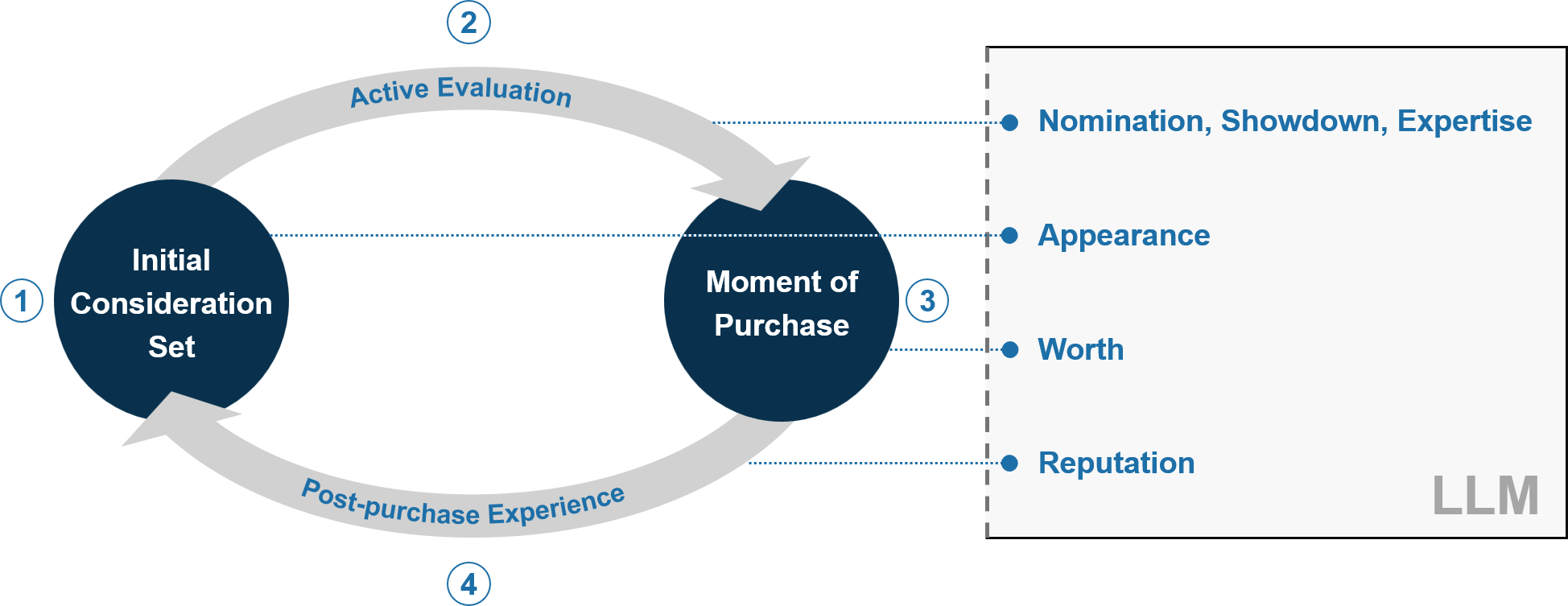
Worth also reinforces the categories before it. Accurate value strengthens your Showdown comparisons, since price often decides between two close options, and it depends on accurate capabilities from Expertise, since value only makes sense against what the product actually does.
What Customers Actually Ask
Worth is measured with price and value prompts:
- "Is [brand] worth the price for a small business?"
- "What's the typical ROI on [brand]?"
- "How much does [brand] cost compared to alternatives?"
The test is whether the engine states your pricing accurately and tells a credible value story.
What Strong and Weak Worth Look Like
Strong Worth looks like accurate pricing paired with a credible value story. The engine quotes the right numbers and frames your cost in terms of what the customer gets, so the price reads as reasonable for the value.
Weak Worth shows up in three patterns. The engine states the wrong price, an outdated tier or a number that was never yours, which is a factual error precisely when accuracy matters most. It frames you as overpriced, repeating a "too expensive" narrative stripped of the value that justifies the cost. Or it gives a price with no value story at all, and a number with nothing to weigh it against always looks like a lot.
How AI Gets Worth Wrong
These errors have familiar causes. Engines synthesize from sources, so if your pricing lives behind a "contact sales" wall or a gated page, the engine cannot read it and reaches for an old or guessed number. Outdated pricing on third-party pages and old reviews lingers and gets repeated. A competitor's framing of you as expensive can be absorbed as neutral fact. And when your value is described in vague benefit language rather than concrete outcomes, the engine has no value story to balance against the price.
We cover the most damaging version in Priced Wrong at the Worst Moment, and we answer the specific questions brands ask in Why Does AI Say My Product Is Overpriced?.
How Worth Is Scored
Within a HiBot audit, each price and value answer is scored from 0 to 4. The accuracy cap applies directly: a wrong price is a material factual error, so the answer is capped at 2 regardless of framing. Those response scores roll up into a Worth score from 0 to 100, weighted at 0.10 in the overall HiBot Score. That is the lowest weight, not because Worth matters least, but because it governs a narrower, later slice of the journey. The full scoring model is explained in How an ANSWER Audit Is Scored.
How to Improve Your Worth
Improving Worth rests on the same idea as the rest of AI visibility: engines synthesize from sources, so the work is giving them accurate pricing and a clear value story to read. This is answer engine optimization (AEO), also called generative engine optimization (GEO), applied to your price and value.
In practice that means publishing clear, current, public pricing wherever you can, stating your value in concrete outcomes rather than vague benefits, providing real ROI and total-cost context an engine can repeat, keeping pricing current everywhere an engine reads it, and correcting the stale or wrong numbers an audit surfaces. The full tactical guide is in How to Improve Your Worth Score, and you can pressure-test how AI reads your pricing with The Pricing-Page Readiness Checklist for AI. To see the arc end to end, read Correcting a Costly Price Error.
Measure before You Act
You cannot correct a price error you have not seen. The first step is to find out how AI represents your price and value, across the engines and markets that matter to you, the way a neutral customer would. A single check is a hint. A real baseline runs many price and value questions, across multiple engines, scored consistently, with every wrong number flagged.
That is what a HiBot audit delivers: your Worth score, the specific pricing errors behind it, and a ranked list of what to fix first. Download the ANSWER whitepaper to see the full framework, or request an AI visibility audit at hibot.com.