Worth is the fourth category in HiBot's ANSWER framework, and it measures whether AI represents your price, value, and return on investment accurately at the decision point. When a customer asks "is [brand] worth the price for a small business" or "how much does [brand] cost," the engine answers with a number and a verdict, and Worth is whether that answer is right and fair.
This is the category that sits closest to the sale. A customer asking about cost and value has stopped exploring and started deciding. If the engine quotes an outdated price, invents a higher one, or frames you as overpriced, it suppresses purchase intent at the exact moment the customer is ready to commit. For the broader framework, see Meet ANSWER.
The Customer Question behind It
Worth answers the customer's question: "Is it worth the money?" By the time someone is weighing price against value, they have largely decided you can do the job and are deciding whether to pay for it. The engine's answer to "is it worth it" becomes the final reassurance or the final objection.
In McKinsey's Consumer Decision Journey, this is the moment of purchase, where price, value, and final reassurance dominate. AI has compressed the pricing-page visit, the ROI calculation, and the "is it worth it" gut check into a single answer, so its read on your value now stands in for all of them.
What the Engine Is Actually Asked
Worth is measured with price and value prompts:
- "Is [brand] worth the price for a small business?"
- "What's the typical ROI on [brand]?"
- "How much does [brand] cost compared to alternatives?"
The test is whether the engine states your pricing accurately and tells a credible value story.
What Strong and Weak Worth Look Like
Strong Worth looks like accurate pricing and a credible value story. The engine quotes the right numbers, frames your cost in terms of what the customer gets, and treats you as fairly priced for the value.
Weak Worth takes a few forms. The engine can state the wrong price, an outdated tier, a number that was never yours, which is a factual error at the worst possible moment. It can frame you as overpriced, repeating a "too expensive" narrative without the value context that justifies the cost. Or it can offer no value story at all, quoting a price with nothing to weigh it against, which makes any number look like a lot.
How Worth Is Scored
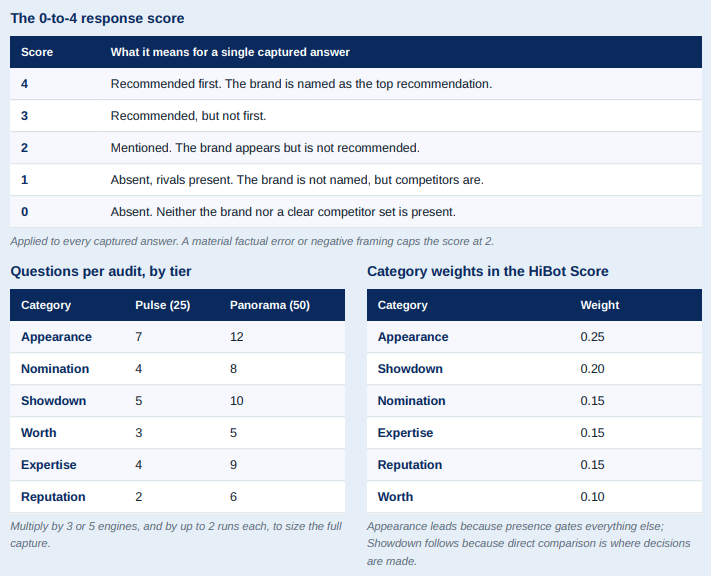
Within an audit, each price and value answer is scored from 0 to 4. The accuracy cap applies directly here: a wrong price is a material factual error, so the answer is capped at 2 no matter how positive the framing. Those scores roll up into a Worth score from 0 to 100. Worth carries the lowest weight in the overall HiBot Score, at 0.10, not because it matters least, but because it applies to a narrower, later slice of the journey. The full model is in How an ANSWER Audit Is Scored.
Why It Matters
Worth is where a strong evaluation can still collapse. A customer can find you, see you nominated, watch you win the comparison, and confirm your capabilities, then ask "is it worth it" and get a wrong price or a "too expensive" framing that ends the deal. Accurate value also reinforces your head-to-head comparisons, since price is often the deciding factor when two options are close.
The first step is to find out how AI represents your price and value, across the engines and markets that matter, the way a neutral customer would see it. For the full guide, see Worth: Making Sure AI Gets Your Price and Value Right, and for tactics, How to Improve Your Worth Score.
Want to know whether AI quotes your price correctly and tells a fair value story? A HiBot audit measures your Worth score across multiple engines and shows you exactly where AI gets your pricing wrong. Download the ANSWER whitepaper to see the full framework, or request an AI visibility audit at hibot.com.