When a customer asks AI "what integrations does [brand] support" or "does [brand] do X," the engine answers with specifics, and the customer treats that answer as fact. Keeping those specifics correct is the job of the fifth ANSWER category: Expertise.
This guide covers what Expertise is, where it sits in the customer journey, how it is scored, how AI gets your product wrong, and how to improve it. For a fast primer, start with What Is Expertise?. For the broader framework, see Meet ANSWER.
What Expertise Measures
Expertise is whether AI describes your features, specifications, and capabilities accurately. It is the factual-accuracy dimension of AI visibility, focused on the product itself rather than your presence, your fit, or your standing. It does not ask whether you are recommended. It asks whether what the engine says you can do is true, complete, and current.
That makes Expertise a quietly decisive category. Customers rely on AI as a fast product expert, pulling capability summaries instead of reading docs and spec sheets. When the engine is right, it does your sales engineering for you. When it is wrong, it disqualifies you on a requirement you actually meet, and you never hear about it.
Where Expertise Sits in the Customer Journey
The ANSWER framework is built on McKinsey's Consumer Decision Journey, and Expertise sits in active evaluation, the stage where customers gather detailed information to narrow their options. AI has collapsed the spec comparison, the documentation, and the feature checklist into a single answer, so its accuracy about your product now stands in for all of those sources at once.
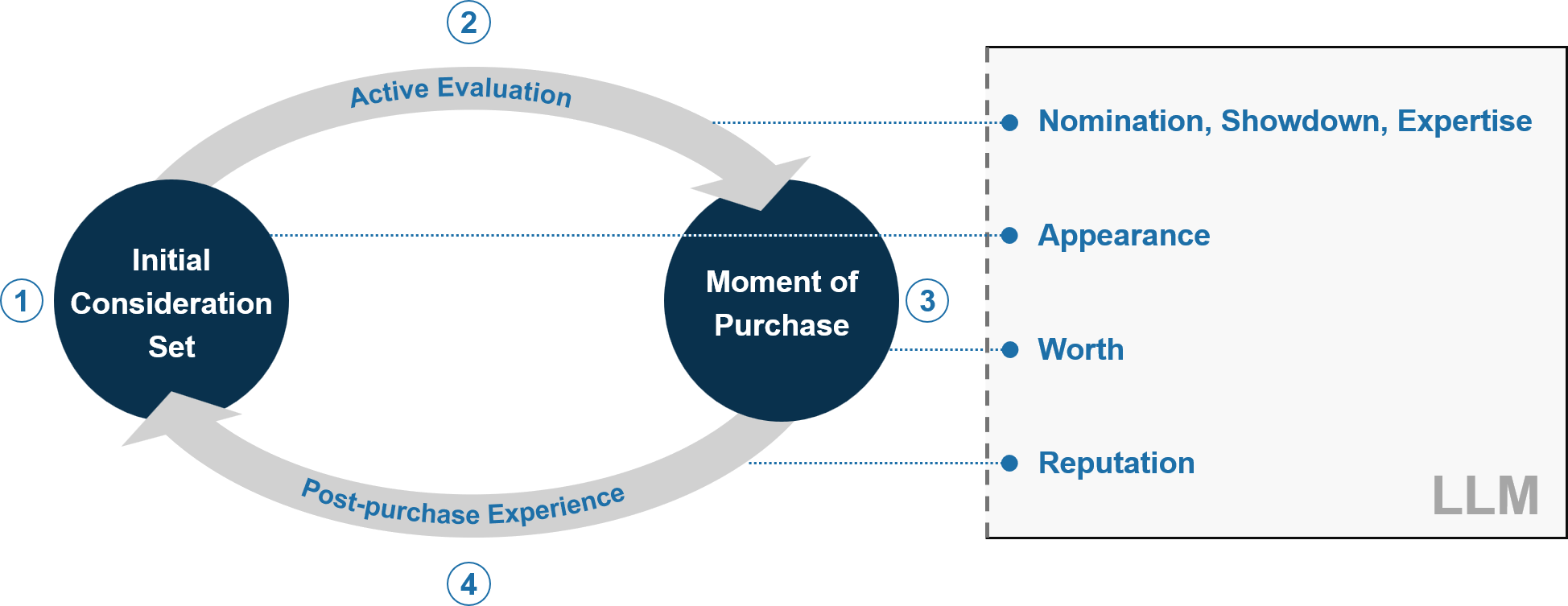
Expertise reinforces the categories around it. Accurate capabilities make your Showdown comparisons fairer and your value story more credible, while a wrong spec can undercut all of them at once.
What Customers Actually Ask
Expertise is measured with specific, capability-level prompts:
- "What integrations does [brand] support?"
- "Does [brand] offer [specific capability]?"
- "What are the technical specifications of [brand's product]?"
The test is whether the engine describes what you do completely, accurately, and currently.
What Strong and Weak Expertise Look Like
Strong Expertise looks like accurate, complete, and current capability descriptions. The engine names real integrations, reflects the version you ship today, and does not invent constraints.
Weak Expertise is where AI accuracy fails, usually in one of four ways. The engine misses a feature you have, so a qualified customer thinks you fall short. It invents a limitation you do not have, a form of AI hallucination that sounds authoritative and goes unchallenged. It describes an outdated version, judging you on a product you no longer ship. Or it confuses you with another brand entirely, attributing someone else's gaps to you.
How AI Gets Expertise Wrong
These errors have understandable causes. Engines synthesize their answers from the sources they can read, so if your own documentation is thin, buried, or written in marketing language rather than plain capability terms, the engine has little accurate material to draw on. Outdated third-party pages and old reviews linger and get repeated. Sparse or ambiguous information invites the model to fill gaps with plausible-sounding guesses, which is how invented limitations appear. And brands with similar names or categories get blended together.
We cover the most damaging version in Invented Limitations and Missing Features, and we answer the specific questions brands ask in Why Does AI List the Wrong Features for My Product?.
How Expertise Is Scored
Within a HiBot audit, each capability answer is scored from 0 to 4. Expertise is where the accuracy cap matters most: a material factual error about your product caps the score at 2, no matter how positive the framing, because a confident wrong answer is not a win. Those response scores roll up into an Expertise score from 0 to 100, weighted at 0.15 in the overall HiBot Score, and they feed the audit's Accuracy Rate metric. The full scoring model is explained in How an ANSWER Audit Is Scored.
How to Improve Your Expertise
Improving Expertise rests on the same idea as the rest of AI visibility: engines synthesize from sources, so the work is giving them clear, accurate, current source material about your product. This is answer engine optimization (AEO), also called generative engine optimization (GEO), applied to your capabilities.
In practice that means publishing plain, factual capability and specification content, keeping integration lists and technical details current everywhere an engine might read them, structuring that content so it is easy to extract, earning citations to your own documentation, and correcting the outdated or wrong claims an audit surfaces. The full tactical guide is in How to Improve Your Expertise Score, and you can pressure-test what AI says about your product with The Capability Accuracy Audit. To see the arc end to end, read Setting the Record Straight on Capabilities.
Measure before You Act
You cannot correct an error you have not seen. The first step is to find out how accurately AI describes your product, across the engines and markets that matter to you, the way a neutral customer would. A single spot check is a hint. A real baseline runs many capability questions, across multiple engines, scored consistently, with every factual error flagged.
That is what a HiBot audit delivers: your Expertise score, your Accuracy Rate, the specific errors behind them, and a ranked list of what to fix first. Download the ANSWER whitepaper to see the full framework, or request an AI visibility audit at hibot.com.