Once a HiBot AI visibility audit has captured what AI engines say about a brand, the work shifts from collection to judgment. A human specialist gathers the answers, and scoring is then applied by AI to the captured text only. The scorer reads what was recorded and never re-queries an engine. That separation matters: the measurement is fixed before it is judged, so the score reflects a stable record rather than a fresh, variable answer.
Scoring runs in 4 levels, from a single answer up to the headline number.
Level 1: The Response Score (0 to 4)
Every captured answer (one question, on one engine, on one run) is scored from 0 to 4 on how prominently the brand appears:
- 4, recommended first. The brand is named as the top recommendation.
- 3, recommended, but not first.
- 2, mentioned. The brand appears but is not recommended.
- 1, absent with rivals present. The brand is not named, but competitors are.
- 0, absent. Neither the brand nor a clear competitor set is present.
There is a crucial guardrail. If an answer contains a material factual error about the brand or frames it negatively, the score is capped at 2, no matter how prominently the brand appears. Being mentioned wrongly is not a win. Each answer also records 2 flags: whether the brand's own domain was cited as a source, and whether there is an accuracy issue.
Levels 2 and 3: From Questions to Categories
Response scores are aggregated to the question level. For Panorama, the 2 runs per engine are averaged first, then averaged across engines. For Pulse, the single runs are averaged across engines. The result is 1 score per question.
Question scores are then grouped into their ANSWER category and averaged, scaled to a 0-to-100 range. This produces a score for each of the 6 categories (Appearance, Nomination, Showdown, Worth, Expertise, and Reputation), so a brand can see exactly where it is strong and where it is leaking.
Level 4: The Headline HiBot Score (0 to 100)
The 6 category scores combine into a single headline HiBot Score using a weighted average. The weights reflect how much each category drives real outcomes:
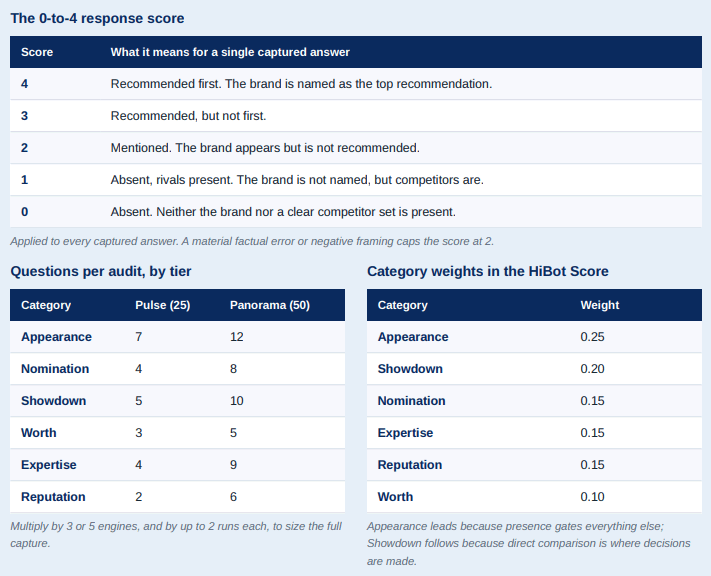
Appearance leads because presence gates everything else, and Showdown follows because direct comparison is where decisions are made. The weights can be tuned per brand when a category matters unusually much for a given business.
What the Number Means
A score is only useful if it carries plain-language meaning, so the headline maps to 1 of 5 bands:
- 80 to 100, Dominant. AI consistently surfaces, recommends, and represents the brand well.
- 60 to 79, Strong. Solid presence with clear room to improve.
- 40 to 59, Emerging. Inconsistent; present in some places, absent or misrepresented in others.
- 20 to 39, Marginal. Largely overlooked, with competitors dominating.
- 0 to 19, Invisible. Effectively absent from AI answers.
Reproducing this chain by hand is no small task. A single audit is hundreds of separate judgments. Each answer is read against the rubric, then averaged across runs and engines, weighted by category, and mapped to a band, all before one chart can be drawn.
Beyond the Headline
A score alone does not tell a brand what to fix, so an audit also reports supplementary metrics. Citation Rate is the share of answers that cite the brand's own domain, a proxy for how much AI draws on the brand's own content. Accuracy Rate is the share of brand mentions that are factually correct and free of negative framing. Share of Voice measures the brand's presence relative to named competitors. And a per-engine HiBot Score breaks the headline out by engine, so a brand can see that it is, say, fine on Perplexity but absent on ChatGPT.
That accuracy lens is the part worth dwelling on. The cap and the Accuracy Rate reframe AI visibility from "are we mentioned" to "are we mentioned correctly," a more demanding and more honest standard than raw mention-counting. Being recommended first is worth little if the engine is confidently telling customers something untrue.
A HiBot audit turns this scoring model into a clear baseline and a prioritized action plan. Download the ANSWER whitepaper for the full methodology, or request an AI visibility audit at hibot.com to see your own score, band, and supplementary metrics.