When a customer asks ChatGPT, Perplexity, or Google's AI answers which product to choose, the AI makes a series of judgments about your brand on the customer's behalf. In a sentence or two, it decides whether to name you, whether to recommend you for the job at hand, how you fare against a named rival, what you cost and whether you are worth it, what you can actually do, and whether you can be trusted.
ANSWER is a framework for measuring each of those judgments. Managing them well is the practice of answer engine optimization (AEO), also called generative engine optimization (GEO). The name is an acronym for its 6 categories, and the order is deliberate. Read A through R and you trace a customer's path from first glance to final trust. Here is what each one measures.
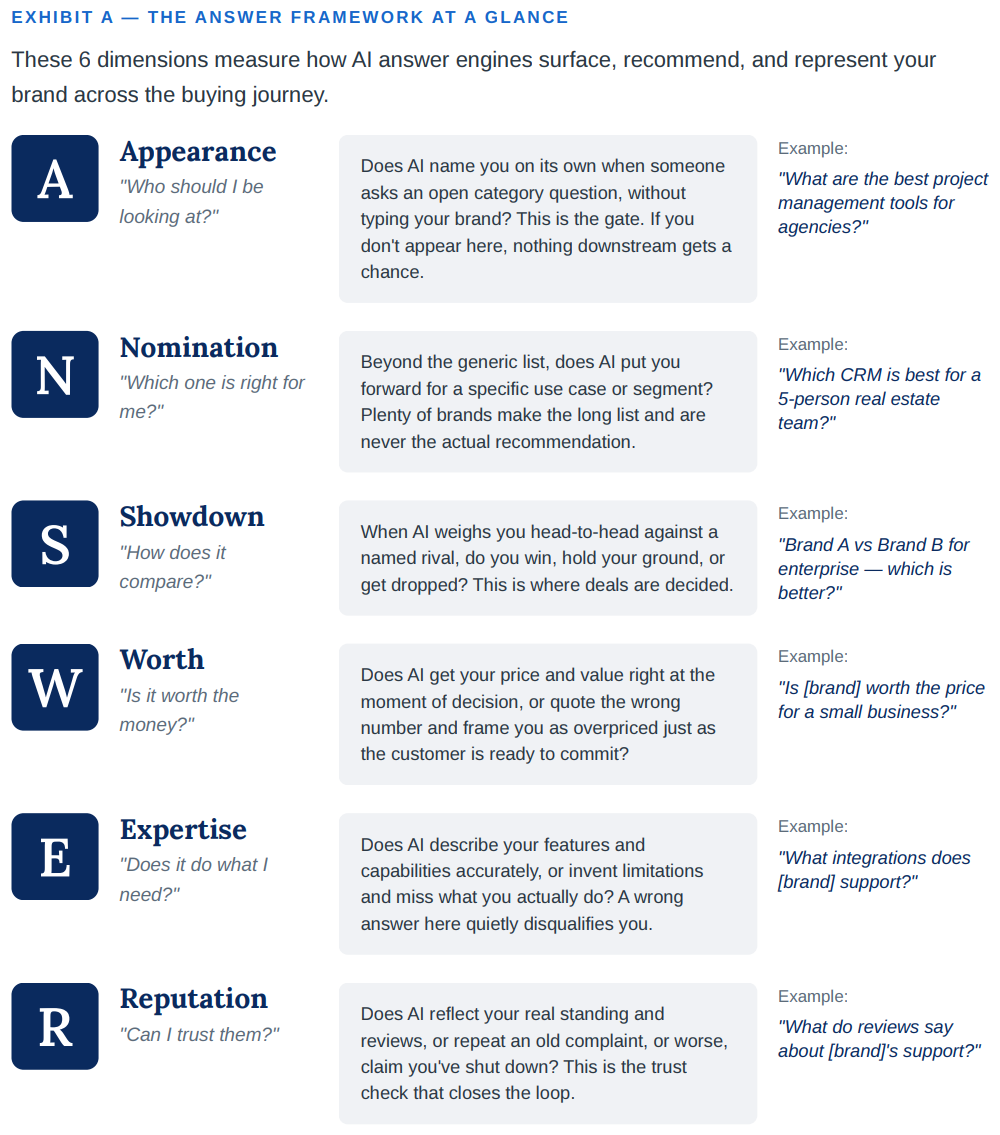
A: Appearance
The customer asks: "Who should I be looking at?"
Appearance is whether AI names your brand on its own when someone asks an open, category-level question, like "what are the best accounting tools for small businesses in 2026," without typing your name. This is the gate. If you don't appear here, nothing downstream gets a chance: you are never compared, priced, or trusted, because you were never in the room. Strong looks like being named, often near the top, across most category queries. Weak looks like being absent while competitors are named as the leaders.
N: Nomination
The customer asks: "Which one is right for me?"
Nomination is whether AI puts you forward for a specific use case, segment, or scenario, such as "which CRM is best for a 5-person real estate team," rather than only listing you. Plenty of brands make the long list and are never the actual recommendation. Nomination is the match between your brand and a real need. Strong looks like being actively recommended for the use cases you serve. Weak looks like appearing in generic lists but never being the suggested fit.
S: Showdown
The customer asks: "How does it compare?"
Showdown is how you fare when AI weighs you head-to-head against a named competitor, as in "Brand A vs Brand B for enterprise, which is better." Do you win, hold your ground, or get dropped? This is where deals are decided, because customers explicitly ask AI to choose. Strong looks like winning or holding your own, with accurate strengths cited. Weak looks like losing, being misrepresented, or being removed before the comparison is even fair.
W: Worth
The customer asks: "Is it worth the money?"
Worth is whether AI gets your price and value right at the moment of decision, or quotes the wrong number and frames you as overpriced just as the customer is ready to commit. Customers ask AI about cost and return before they commit, and a bad answer here suppresses purchase intent at the worst possible moment. Strong looks like accurate pricing and a credible value story. Weak looks like wrong numbers, a "too expensive" framing, or no value story at all.
E: Expertise
The customer asks: "Does it do what I need?"
Expertise is whether AI describes your features, specifications, and capabilities accurately, or invents limitations and misses what you actually do. Customers rely on AI to summarize what a product can do, and a wrong answer here quietly disqualifies you or sets up disappointment. Strong looks like accurate, complete, current capability descriptions. Weak looks like missing features, fabricated limitations, or outdated information.
R: Reputation
The customer asks: "Can I trust them?"
Reputation is whether AI reflects your real standing and reviews, or repeats an old complaint, or worse, claims you have shut down. It is the trust check that closes the loop, and it shapes both new customers' confidence and existing customers' willingness to stay. Strong looks like AI conveying solid standing and positive reviews. Weak looks like negative framing, repeated complaints, or an outright false claim.
The Order Is the Point
The acronym is not arbitrary. Appearance is the gate into the journey, which is why a low Appearance score caps everything below it. A brand AI never surfaces is never nominated, compared, priced, or trusted. Nomination, Showdown, and Expertise sit in the contested evaluation stage. Worth lands at the moment of purchase. Reputation closes the loop and shapes the next customer.
Read top to bottom, the 6 trace a customer from first glance to final trust. Score them, and you have a map of exactly where AI is helping you, and where it is quietly costing you.
The ANSWER whitepaper walks through all 6 categories in full, with the example prompts and scoring behind each. Download it to see the complete framework, or request a HiBot AI visibility audit at hibot.com to get your own baseline. Exhibit A, above, is excerpted from this whitepaper.