American Express scores 82 out of 100 for AI visibility and sits in the Dominant band. ChatGPT, Perplexity, and Google name Amex in 42% of category answers, first of six issuers, describe its cards correctly, and score Expertise a flawless 100. Then a customer asks the question that decides a card, which one is better, and in every sampled head-to-head the engines pick Chase or Capital One. On top of that, several answers attach a wrong number or an invented product to an otherwise strong recommendation.
That split, winning the brand question and losing the comparison, runs through the whole audit. We ran Amex through a HiBot Pulse audit across the three engines customers actually use and scored every answer by hand on the ANSWER framework. Here is where AI gets Amex right, where it goes wrong, and what we would fix first.
The American Express Scorecard at a Glance
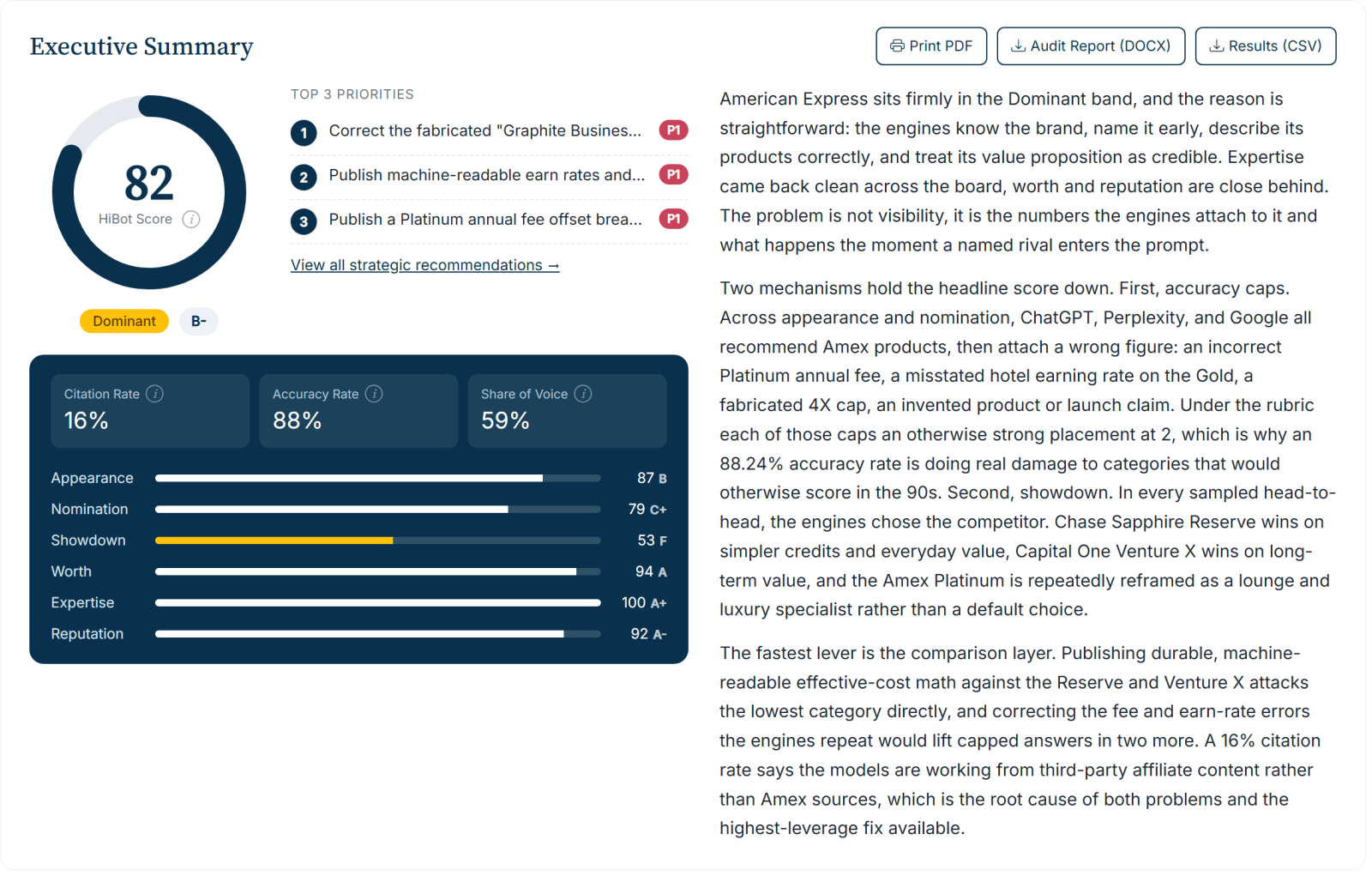
The Score Dashboard opens every report with the headline number, the six dimensions, and the two rates that describe engine behavior. Amex reads 82 and Dominant, with Expertise perfect at 100 and Showdown, the head-to-head, flagged as the weak point at 53. Accuracy sits at 88% and the citation rate at 16%.
| ANSWER dimension | What it measures | Score |
|---|---|---|
| Appearance | Does AI name you at all? | 87 (B) |
| Nomination | Does AI recommend you for a specific need? | 79 (C+) |
| Showdown | Does AI pick you in a head-to-head? | 53 (F) |
| Worth | Does AI frame you as worth the price? | 94 (A) |
| Expertise | Does AI describe what you do accurately? | 100 (A+) |
| Reputation | Does AI say you can be trusted? | 92 (A-) |
Every screen here is from Amex's actual report. Download the full audit to read it end to end.
What AI Gets Right About American Express
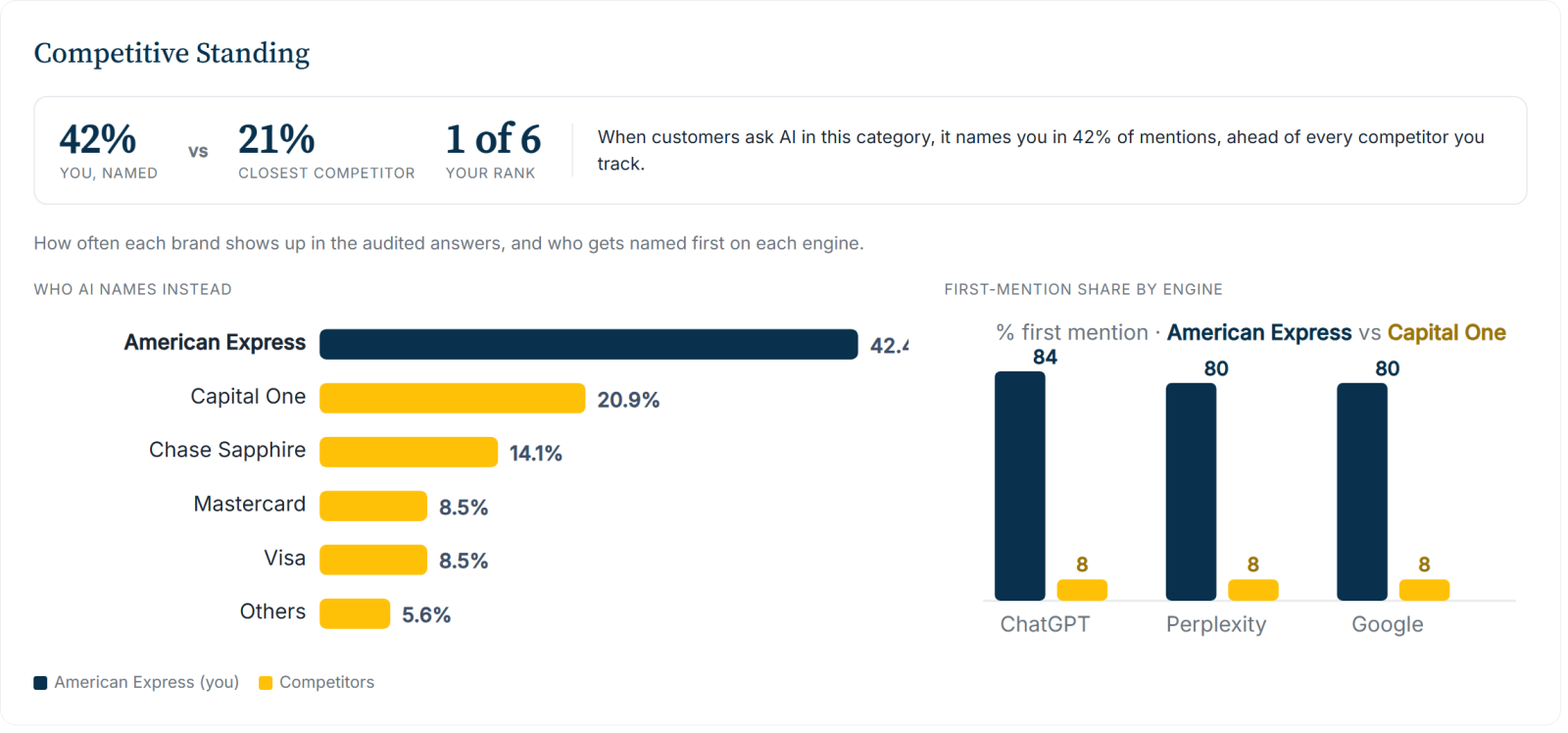
At the brand level Amex is in commanding shape. It is named in 42% of answers and ranks first of six against Capital One, Chase, Mastercard, and Visa, which the Competitive Standing section leads with. Expertise is a perfect 100, so the engines describe the cards, the rewards, and the benefits accurately. Worth is a 94 and Reputation a 92. When a customer asks what Amex is and whether it is any good, the engines answer with confidence and get it right.
Where American Express Loses the Customer
The weakness is severe and specific. Showdown scores 53, an F, and it is the lowest dimension by more than thirty points. In every sampled comparison the engines chose the competitor. The Chase Sapphire Reserve wins on simpler credits and everyday value, the Capital One Venture X wins on long-term value, and the Amex Platinum is framed as premium but harder to justify. Amex is present in the comparison every time. It is simply not the pick, which is the moment a card gets chosen. The ANSWER Deep Dive shows each losing answer with a one-click path to the verbatim text.
The Facts AI Gets Wrong About American Express
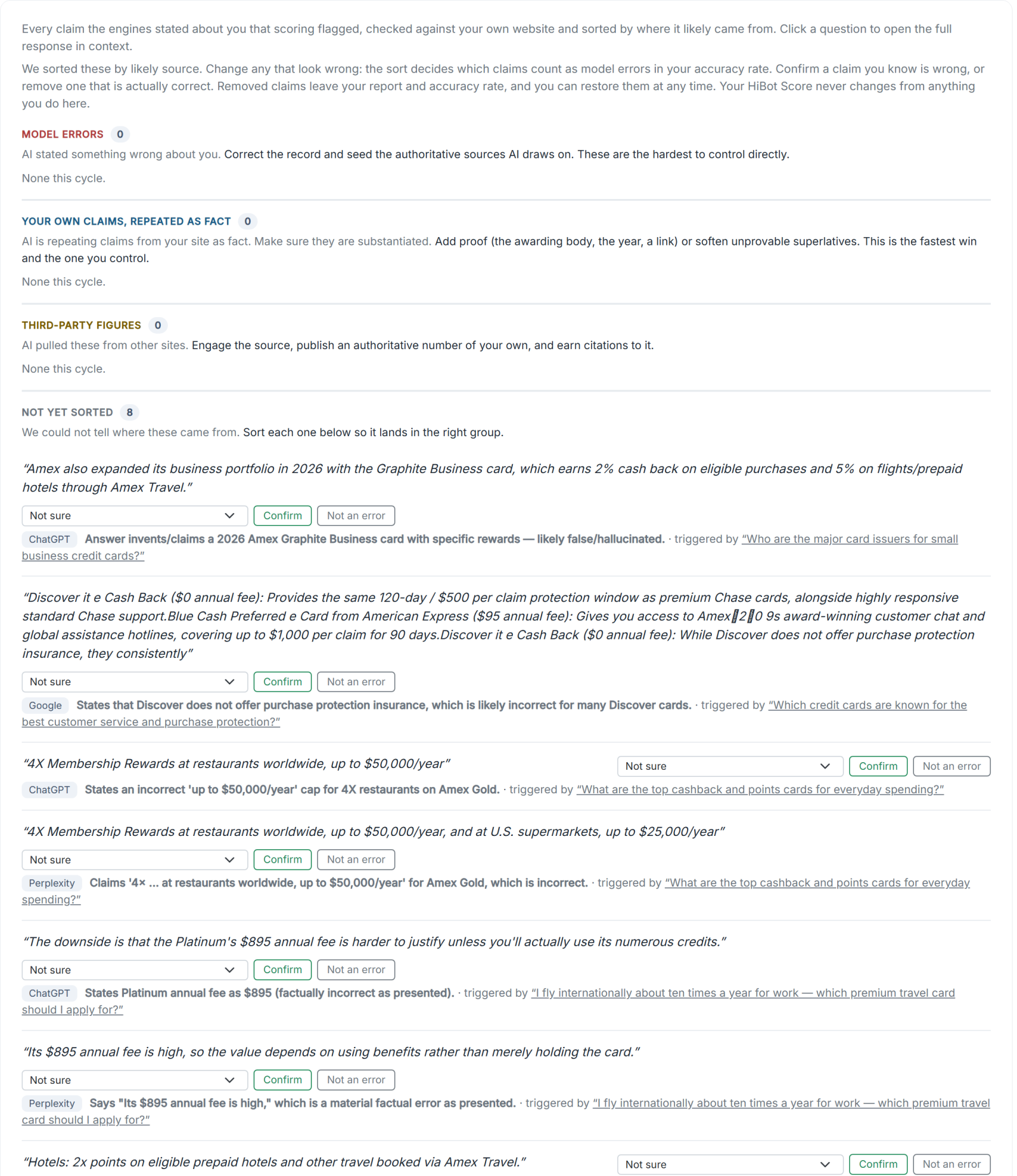
The second drag is accuracy, and it is doing real damage. The Claims AI States as Fact log flagged eight claims, which is why an 88% accuracy rate pulls down categories that would otherwise score in the 90s. The engines recommend an Amex product and then attach a wrong figure: an incorrect Platinum annual fee, a misstated hotel earning rate on the Gold card, a fabricated 4X cap. ChatGPT went further and invented a product outright, a 2026 "Graphite Business card" that does not exist. Each fabrication sits inside an answer a real applicant would have read as authoritative, and under the scoring rubric a single wrong fact caps an otherwise strong placement.
Why This Happens
The root cause shows up in the citation rate of 16%. Most answers about Amex cite no source Amex controls, so the engines assemble fees, caps, and even product names from third-party memory. The Citations and Sources Log captured the full set they did cite, and little of it was Amex's own. When the models have nothing authoritative to read, a wrong Platinum fee and an invented card have nothing to correct them. The fix for a weak Showdown and the fix for a fabricated fee are the same: give the engines an Amex-owned source to cite.
What We Would Fix First
The report ranks the plan and sequences it on the 90-day roadmap. For Amex, three moves recover the most ground. First, publish a canonical, machine-readable product index that kills the invented Graphite card and pins every current card name. Second, publish machine-readable earn rates, fees, and benefit limits for every card, which directly removes the fabricated figures capping the best answers. Third, publish a Platinum fee-offset breakdown that shows realistic credit redemption, so the engines stop framing the annual fee as a reason to pick Chase.
What This Means for Your Brand
Amex is proof that a perfect Expertise score is not the same as winning the sale. A brand can be named first, described flawlessly, and trusted, and still lose every head-to-head and have its best answers capped by an invented fee. Most brands are not starting from a perfect 100 on Expertise. If AI quietly hands an Amex-sized brand to a rival at the point of choice, it is worth knowing what it is doing to yours. For the full tour of what a report contains, see our complete look inside an AI visibility audit, and for why the buying journey now runs through a single AI conversation, see AI is the new front door to your brand.
Frequently Asked Questions
Is American Express visible in AI search?
Yes. Amex scored 82 out of 100 and landed in the Dominant band, named in 42% of AI answers across ChatGPT, Perplexity, and Google and ranked first of six issuers. Its visibility is strong; the weakness is in head-to-head comparison questions and in factual accuracy.
Which credit card does AI recommend over Amex?
On direct comparisons the engines favored the Chase Sapphire Reserve on simpler credits and everyday value and the Capital One Venture X on long-term value. Amex appears in nearly every comparison but is rarely the final pick.
What facts does AI get wrong about American Express?
The audit flagged eight claims, including an incorrect Platinum annual fee, a misstated Gold hotel earning rate, a fabricated 4X cap, and an entirely invented 2026 "Graphite Business card." Each sat inside an otherwise favorable answer.
Which AI engines were tested, and how?
Amex was run through a HiBot Pulse audit across ChatGPT, Perplexity, and Google. Every answer was captured by hand in a neutral, logged-out session and scored on the six-dimension ANSWER framework.
How is AI visibility measured?
HiBot scores a brand on the ANSWER framework: Appearance, Nomination, Showdown, Worth, Expertise, and Reputation, each tied to a real moment in how customers decide, rolled into a single 0 to 100 score.
Methodology and Independence
This audit is an independent HiBot Pulse report run by hand by a human AI specialist across ChatGPT, Perplexity, and Google, scored on the ANSWER methodology. It is not endorsed by or affiliated with American Express. When an engine invents a product or a fee, we report it as the engine's output, not as a statement by the brand, and keep the net story fair.
To see the questions your own customers are asking AI, generate them free at hibot.com, no sign-up, in about thirty seconds. You can download the full American Express report, browse every component on the features page, or read more brand audits in the exact format shown here.