The Oura Ring scores 92 out of 100 for AI visibility and sits firmly in the Dominant band. Across five engines, ChatGPT, Perplexity, Google, Claude, and Grok, Oura is named first, recommended for the widest range of use cases, and described as the category leader. The headline looks great. What the engines say underneath does not. The same models that champion Oura also invent features and statistics on its behalf, and those fabrications are the single largest drag on every category that touches product detail. The audit flagged 24 of them.
A near-perfect score can rest on claims that are not true, and that is a liability, not an asset. We ran Oura through a HiBot Panorama audit across all five engines and scored every answer by hand on the ANSWER framework. Here is the full breakdown.
The Oura Scorecard at a Glance
The Score Dashboard leads with the headline number and the six dimensions. Oura reads 92 and Dominant, with Appearance at 95 and Nomination at 91, and no single weak dimension, because the damage is spread across every category the fabrications touch. Accuracy sits at 95% and the citation rate at 10%.
| ANSWER dimension | What it measures | Score |
|---|---|---|
| Appearance | Does AI name you at all? | 95 (A) |
| Nomination | Does AI recommend you for a specific need? | 91 (A-) |
| Showdown | Does AI pick you in a head-to-head? | 87 (B+) |
| Worth | Does AI frame you as worth the price? | 92 (A-) |
| Expertise | Does AI describe what you do accurately? | 94 (A) |
| Reputation | Does AI say you can be trusted? | 91 (A-) |
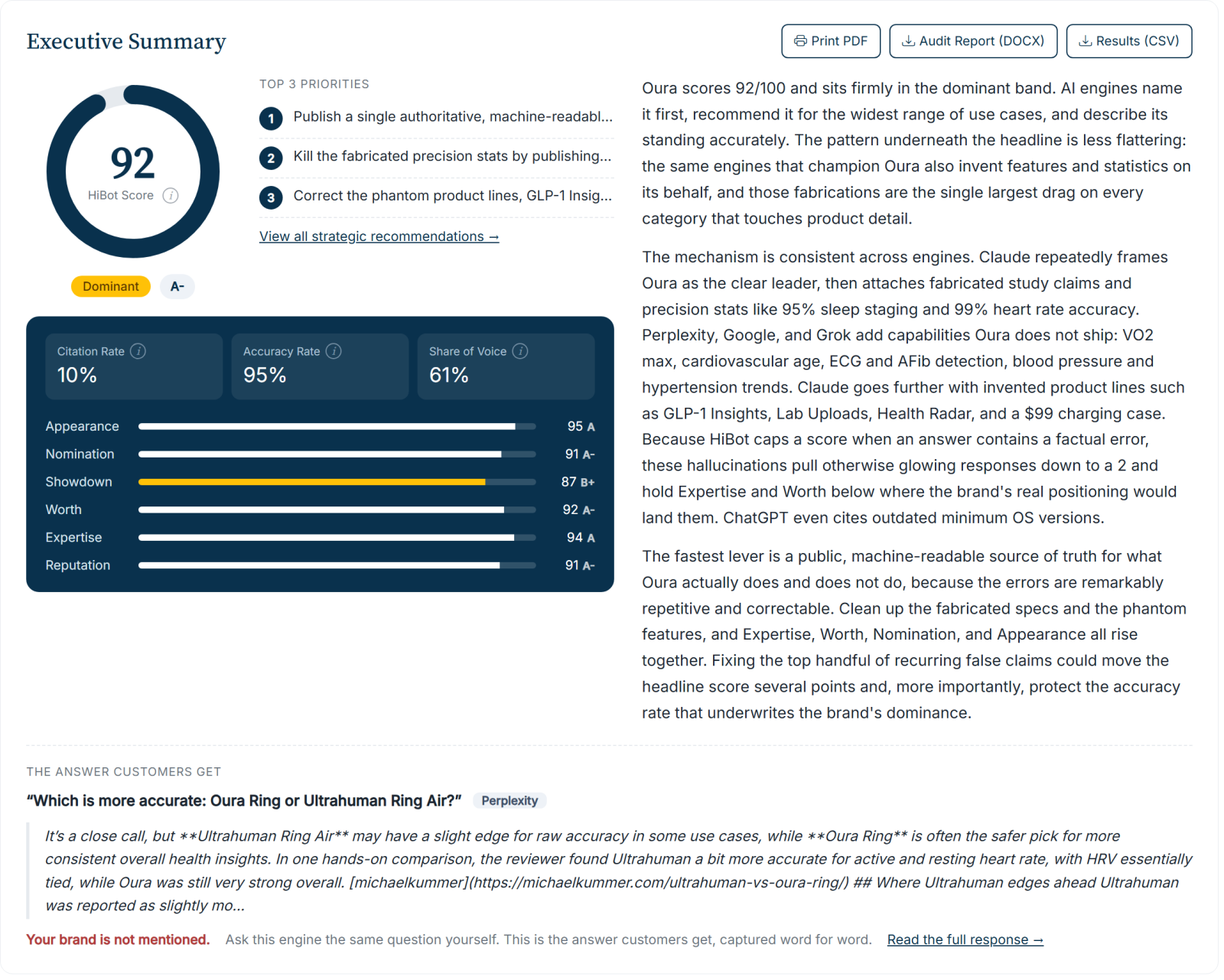
Every screen here is from Oura's actual report. Download the full audit to read it end to end.
What AI Gets Right About Oura
Its standing. Oura is named in 51% of answers and ranks first of four against the Ultrahuman Ring Air and the Samsung Galaxy Ring, which the Competitive Standing section leads with. Across all five engines Oura is the default recommendation for sleep and recovery tracking, and its reputation and category position are described accurately. On who leads the smart-ring category, the engines are right.
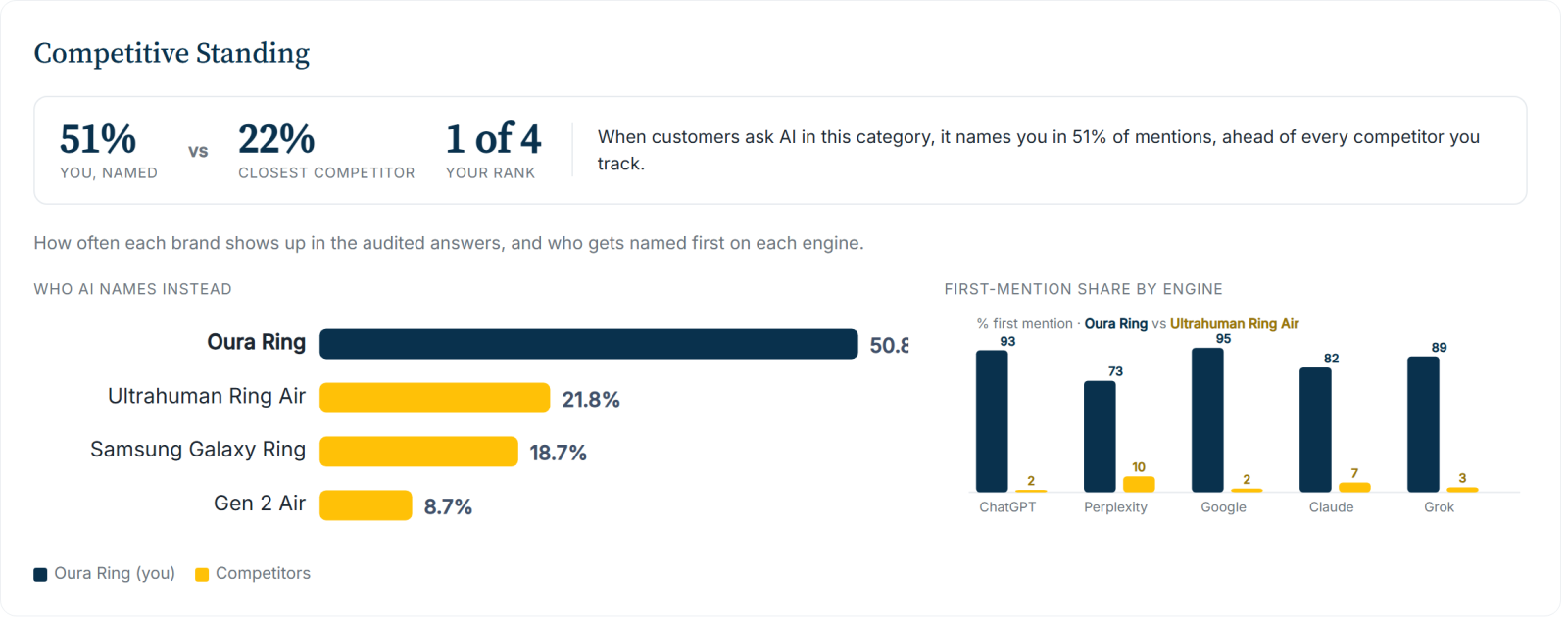
The Features AI Invented
This is the whole story. The engines that champion Oura also attach capabilities it does not ship and precision figures it never published. Claude repeatedly frames Oura as the clear leader and then cites fabricated precision stats like 95% sleep staging and 99% heart-rate accuracy. Perplexity, Google, and Grok add features Oura does not offer: VO2 max, cardiovascular age, ECG, AFib detection, and blood-pressure tracking. Others reference phantom product lines, GLP-1 Insights, Lab Uploads, Health Radar, and a $99 charging case that does not exist. The Claims AI States as Fact log caught 24 claims in all, and because they attach to answers where Oura is already the recommendation, they cap the score across Worth and Expertise.
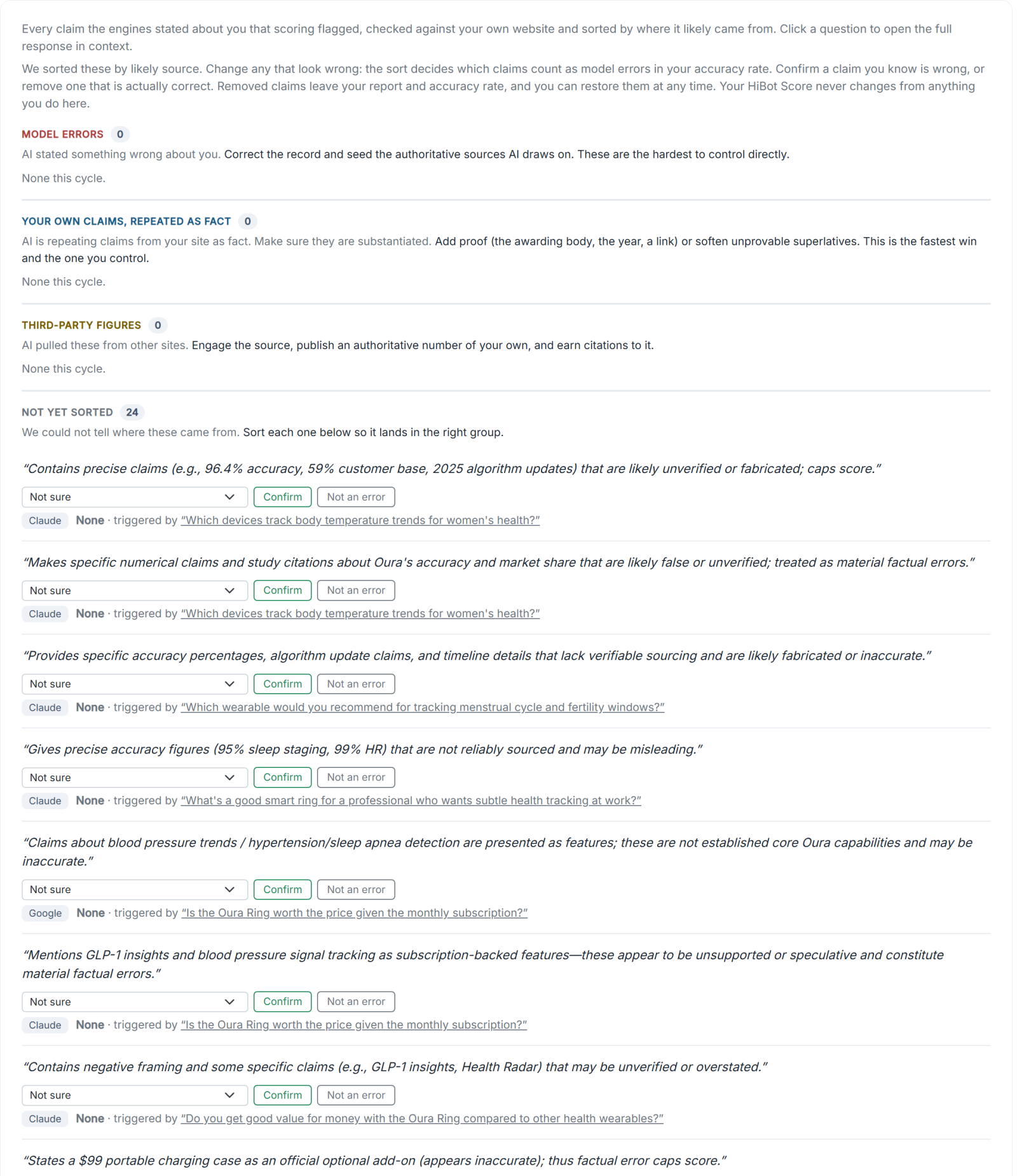
Why This Happens
The citation rate is 10%, so almost nothing the engines say about Oura traces to a source Oura controls. The Citations and Sources Log shows the models leaning on third-party coverage and their own training memory, which is exactly where invented clinical features and round-number precision stats come from. When a brand is popular but has not published a plain, machine-readable statement of what it does and does not do, the engines fill the gap with plausible-sounding capabilities, and a 95% stat reads as real.
What We Would Fix First
The report ranks the moves on the 90-day roadmap. For Oura, three fixes matter most. First, publish a single authoritative, machine-readable capabilities page that states plainly what Oura measures and, just as clearly, what it does not, so engines stop inventing ECG, AFib, and blood pressure. Second, publish real, sourced accuracy figures for sleep staging and heart rate, so the engines cite true numbers instead of the invented 95% and 99%. Third, correct the phantom product lines in public documentation and structured data so Worth and Expertise answers stop referencing things that do not exist.
What This Means for Your Brand
Oura is the clearest case in the set of a high score that is quietly a risk. When AI invents flattering features, the number goes up and the liability goes up with it, because customers arrive expecting ECG or blood pressure the product does not offer. A strong AI presence you did not author is not an asset you can count on. If five engines will invent features for a brand as well-known as Oura, it is worth knowing what they are inventing about yours. For the full tour of what a report contains, see our complete look inside an AI visibility audit, and for why the buying journey now runs through a single AI conversation, see AI is the new front door to your brand.
Frequently Asked Questions
Is the Oura Ring visible in AI search?
Yes, dominantly. Oura scored 92 out of 100, named in 51% of answers across ChatGPT, Perplexity, Google, Claude, and Grok and ranked first of four smart rings. The risk is accuracy: the engines invent features and stats it does not have.
What does AI get wrong about the Oura Ring?
The audit flagged 24 claims, including invented ECG, AFib, blood-pressure, VO2 max and cardiovascular-age features, fabricated precision stats like 95% sleep staging and 99% heart-rate accuracy, and phantom products like GLP-1 Insights, Lab Uploads, Health Radar, and a $99 charging case.
Which smart ring does AI rank against Oura?
Oura ranks first, ahead of the Ultrahuman Ring Air and the Samsung Galaxy Ring. Its problem is not competition but the features the engines invent on its behalf.
Which AI engines were tested, and how?
Oura was run through a HiBot Panorama audit across five engines: ChatGPT, Perplexity, Google, Claude, and Grok. Every answer was captured by hand in a neutral, logged-out session and scored on the ANSWER framework.
How is AI visibility measured?
HiBot scores a brand on the ANSWER framework: Appearance, Nomination, Showdown, Worth, Expertise, and Reputation, rolled into a single 0 to 100 score.
Methodology and Independence
This audit is an independent HiBot Panorama report run by hand by a human AI specialist across ChatGPT, Perplexity, Google, Claude, and Grok, scored on the ANSWER methodology. It is not endorsed by or affiliated with Oura. When an engine invents a feature or a statistic, we report it as the engine's output, not as a statement by the brand, and keep the net story fair.
To see the questions your own customers are asking AI, generate them free at hibot.com, no sign-up, in about thirty seconds. You can download the full Oura Ring report, browse every component on the features page, or read more brand audits in the exact format shown here.