Expertise is the fifth category in HiBot's ANSWER framework, and it measures whether AI describes your features, specifications, and capabilities accurately. It is the factual-accuracy dimension of AI visibility, focused on the product itself. When a customer asks "what integrations does [brand] support" or "does [brand] do X," the engine answers with specifics, and Expertise is whether those specifics are right.
This matters because customers treat AI as a fast, trustworthy product expert. They rely on it to summarize what a tool can do before they ever visit your site. If the engine invents a limitation you do not have, misses a feature you ship, or confuses you with another brand, it quietly disqualifies you or sets up a disappointment later. For the broader framework, see Meet ANSWER.
The Customer Question behind It
Expertise answers the customer's question: "Does it actually do what I need?" By the time someone is checking specific capabilities, they are seriously evaluating you. They have a requirement in mind, a particular integration, a compliance need, a technical spec, and they are asking AI to confirm you meet it. A wrong answer here ends the evaluation before you can correct it.
In McKinsey's Consumer Decision Journey, this sits in active evaluation, the stage where customers gather detailed information. AI has compressed the spec sheet, the docs, and the feature comparison into a single answer, so its accuracy about your product now stands in for all of them.
What the Engine Is Actually Asked
Expertise is measured with specific, capability-level prompts:
- "What integrations does [brand] support?"
- "Does [brand] offer [specific capability]?"
- "What are the technical specifications of [brand's product]?"
The test is whether the engine describes what you do completely, accurately, and currently.
What Strong and Weak Expertise Look Like
Strong Expertise looks like accurate, complete, and current capability descriptions. The engine gets your features right, names real integrations, and reflects what you ship today.
Weak Expertise is where AI accuracy breaks down. The engine can miss features you actually have, invent limitations you do not, describe an old version of your product, or confuse you with a competitor. This last category, where AI states something confidently and wrongly, is a form of AI hallucination, and it is especially damaging because it sounds authoritative to the customer.
How Expertise Is Scored
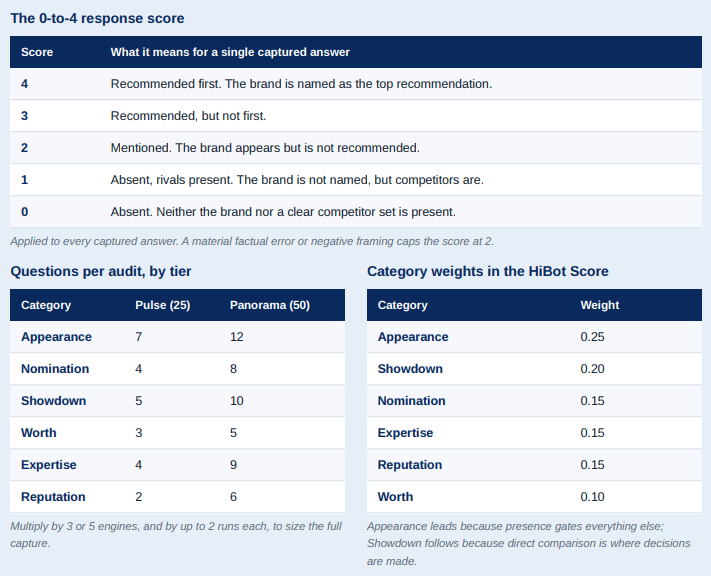
Within an audit, each capability answer is scored from 0 to 4. Expertise is where the accuracy cap bites hardest: if an answer contains a material factual error about your product, the score is capped at 2 no matter how positively you are framed, because a confident wrong answer is not a win. Those scores roll up into an Expertise score from 0 to 100, weighted at 0.15 in the overall HiBot Score. Expertise also drives the audit's Accuracy Rate metric. The full model is in How an ANSWER Audit Is Scored.
Why It Matters
Appearance gets you named and Showdown wins the comparison, but Expertise decides whether the customer can trust the details, and accurate details feed everything around them. Correct capabilities make your head-to-head comparisons fairer and your value story credible. A wrong spec, by contrast, can sink a deal silently, because the customer simply crosses you off based on a requirement you actually meet.
The first step is to find out how accurately AI describes your product, across the engines and markets that matter, the way a neutral customer would see it. For the full guide, see Expertise: How to Keep AI Accurate about What You Do, and for tactics, How to Improve Your Expertise Score.
Want to know whether AI describes your product accurately? A HiBot audit measures your Expertise score and Accuracy Rate across multiple engines and shows you exactly what AI gets wrong. Download the ANSWER whitepaper to see the full framework, or request an AI visibility audit at hibot.com.