When a customer asks AI "is [brand] reliable" or "is this a company I can trust," the engine renders a verdict, and the customer takes it at face value. Making sure that verdict is fair and accurate is the job of the sixth ANSWER category: Reputation.
This guide covers what Reputation is, where it sits in the customer journey, how it is scored, how AI gets your standing wrong, and how to improve it. For a fast primer, start with What Is Reputation?. For the broader framework, see Meet ANSWER.
What Reputation Measures
Reputation is whether AI reflects your standing, reviews, and trust signals accurately. It is the credibility dimension of AI visibility, focused on whether the engine treats you as reliable and safe to buy from. It does not ask whether you are surfaced or recommended. It asks whether, when trust is the question, the engine's answer matches reality.
That makes Reputation the category that can undo everything else. A trust question is the final gate before a purchase and the first doubt an existing customer reconsiders. A fair answer reassures, while a false or hostile one ends the relationship, sometimes before it begins.
Where Reputation Sits in the Customer Journey
The ANSWER framework is built on McKinsey's Consumer Decision Journey, and Reputation maps to the post-purchase experience and the loyalty loop, where usage and word of mouth feed the next decision. AI now mediates that loop, so its summary of your reviews and standing shapes whether the next customer ever puts you in their consideration set.
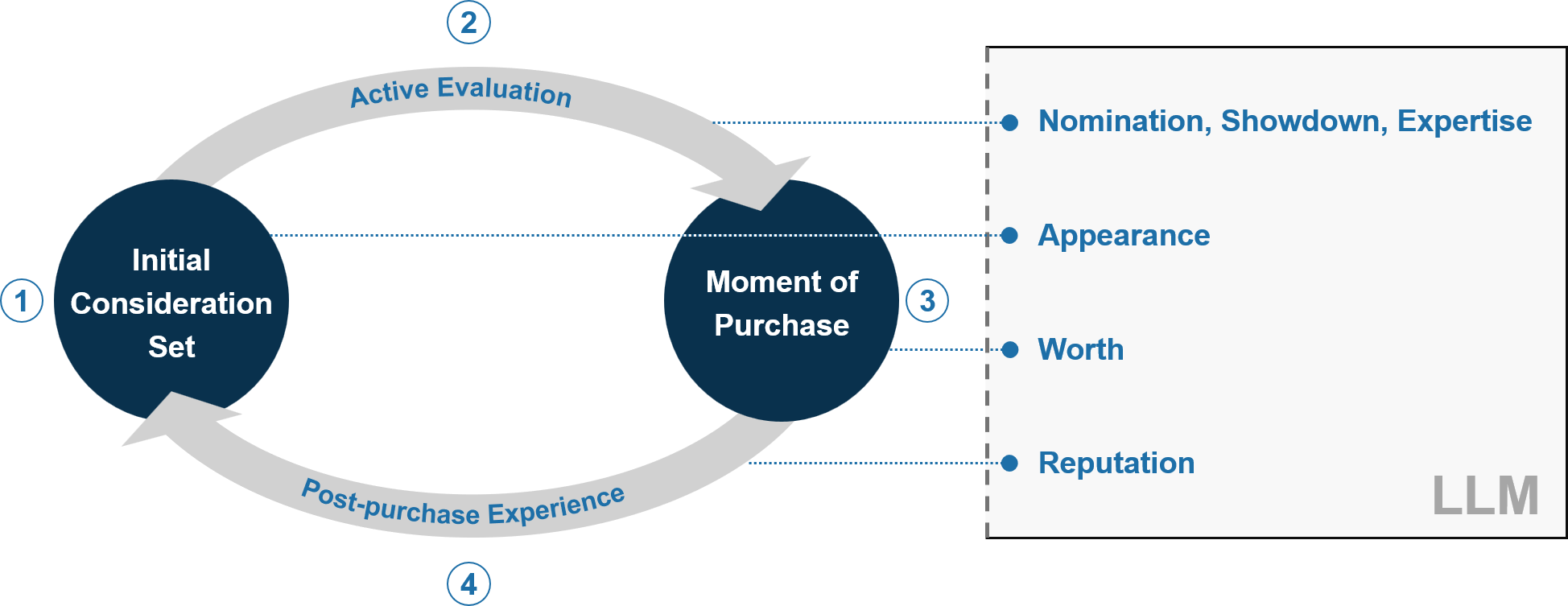
Reputation closes the loop that Appearance opens. A poisoned trust answer does not just lose one deal, it lowers the odds that the next customer considers you at all, which is why this category, last in the acronym, feeds straight back to the first.
What Customers Actually Ask
Reputation is measured with trust and standing prompts:
- "Is [brand] reliable and reputable?"
- "What do reviews say about [brand]'s support?"
- "Is [brand] a trustworthy company to buy from?"
The test is whether the engine reflects your real standing fairly, rather than amplifying a stale negative or inventing one.
What Strong and Weak Reputation Look Like
Strong Reputation looks like AI conveying solid standing, positive reviews, and genuine trust, in line with reality. The engine treats you as reliable and safe to buy from.
Weak Reputation shows up in three patterns. The engine frames you negatively, leaning on a critical narrative that no longer reflects you. It repeats a specific old complaint as if it were current, giving a resolved issue a second life. Or it states an outright falsehood, that you have shut down, suffered a breach you never had, or lost a certification you still hold, which is a confident AI hallucination that does real damage.
How AI Gets Reputation Wrong
These failures have understandable causes. Engines synthesize from the sources they can read, so a loud old controversy, a cluster of dated negative reviews, or a single viral complaint can dominate the picture long after the reality has changed. Thin recent trust signals leave the old narrative unchallenged. Brands with similar names get blended, so another company's scandal attaches to you. And sparse information invites the model to guess, which is how a "did they go out of business" question becomes a confident yes.
We cover the most catastrophic version in When AI Says You've Shut Down, and we answer the specific questions brands ask in Why Does AI Repeat an Old Complaint about My Company?.
How Reputation Is Scored
Within a HiBot audit, each trust answer is scored from 0 to 4. The accuracy cap applies sharply: a false or materially negative claim caps the answer at 2 regardless of any positives, because a damaging untruth is not a win. Those response scores roll up into a Reputation score from 0 to 100, weighted at 0.15 in the overall HiBot Score, and they feed the audit's Accuracy Rate. The full scoring model is explained in How an ANSWER Audit Is Scored.
How to Improve Your Reputation
Improving Reputation rests on the same idea as the rest of AI visibility: engines synthesize from sources, so the work is making sure the trust signals an engine reads are current, credible, and accurate. This is answer engine optimization (AEO), also called generative engine optimization (GEO), applied to your standing.
In practice that means maintaining strong, recent reviews on the platforms engines trust, keeping your company facts current and consistent so falsehoods have nothing to feed on, publishing clear trust signals such as security, certifications, and customer outcomes, addressing the live negative narratives at their source, and monitoring for false claims so you can correct them fast. The full tactical guide is in How to Improve Your Reputation Score, and you can pressure-test what AI says about your trust with The Trust-Signal Checklist for AI Visibility. To see the arc end to end, read Recovering from a Poisoned Reputation Answer.
Measure before You Act
You cannot correct a false claim you have not seen, and reputation errors are the ones customers least often report. The first step is to find out how AI characterizes your trust and standing, across the engines and markets that matter to you, the way a neutral customer would. A single check is a hint. A real baseline runs many trust questions, across multiple engines, scored consistently, with every false or hostile claim flagged.
That is what a HiBot audit delivers: your Reputation score, your Accuracy Rate, the specific claims behind them, and a ranked list of what to fix first. Download the ANSWER whitepaper to see the full framework, or request an AI visibility audit at hibot.com.