When a customer asks AI "which CRM is best for a 5-person real estate team," the engine does not recite the category. It puts one or two brands forward for that exact job. Being the brand it nominates is the work of the second ANSWER category: Nomination.
This guide covers what Nomination is, where it sits in the customer journey, how it is scored, how AI gets it wrong, and how to improve. For a fast primer, start with What Is Nomination?. For the broader framework, see Meet ANSWER.
What Nomination Measures
Nomination is whether AI recommends you for a specific use case, segment, or scenario, rather than only listing you in a broad answer. It is the match between your brand and a real need. Appearance is presence in the category. Nomination is fit for the job. The two are easy to confuse and very different to fix, because a brand can be named in every broad list and still never be the recommendation when a customer describes their actual situation.
That makes Nomination a high-intent category. The scenario question comes from a customer who has stopped asking who the options are and started asking which one is right for them. The brand the engine nominates gets the next step.
Where Nomination Sits in the Customer Journey
The ANSWER framework is built on McKinsey's Consumer Decision Journey, and Nomination sits in active evaluation, the stage where a customer narrows the field by fit. This is where the most decisions are shaped, and AI now does the narrowing. Instead of a customer working out which option suits their team size, industry, or constraint, the engine matches a brand to the described need and hands back a name.
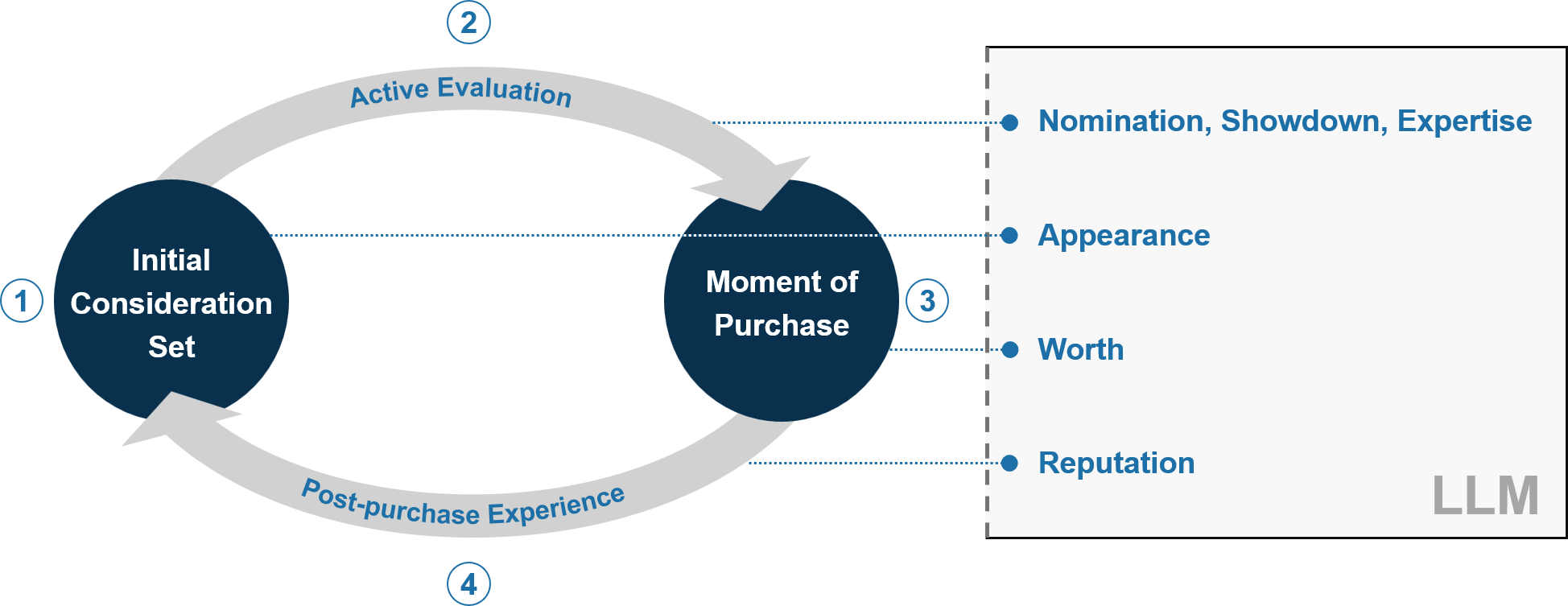
Nomination depends on Appearance. You cannot be recommended for a use case if you are not surfaced in the category at all, so if you are still missing from broad answers, start with the Appearance guide. Once you are present, Nomination is about converting that presence into the recommendation for the jobs you actually serve.
What Customers Actually Ask
Nomination is measured with specific, scenario-level prompts:
- "Which CRM is best for a 5-person real estate team?"
- "What's a good collaborative robot supplier for a mid-size factory?"
- "Recommend a payroll tool for a remote-first startup."
The test is whether the engine puts you forward as the fit for the use cases you serve.
What Strong and Weak Nomination Look Like
Strong Nomination looks like being actively recommended for the scenarios you are built for, named as the suggested choice when a customer describes a situation you serve well, with the reason tied to a real strength.
Weak Nomination looks like making the broad list and never the specific pick. You appear when the question is general and vanish when it gets precise, so a surface check feels reassuring while the high-intent questions go to a competitor. A particularly costly version is being nominated for the wrong scenarios and skipped for your best ones, which sends you mismatched prospects while your ideal customers are pointed elsewhere.
How AI Gets Nomination Wrong
Nomination fails for understandable reasons. The engine may not have clear evidence that you serve a given scenario, because your content speaks in general terms rather than naming the use cases, segments, and team sizes you fit. A competitor may have published detailed use-case content that claims the scenario first. Your strongest use cases may be buried under abstract positioning that an engine cannot map to a concrete situation. And the sources the engine reads may describe you for an older or narrower set of jobs than you serve today.
We cover the most common version in On the List, Never the Pick, and we answer the specific questions brands ask in How Does AI Decide Which Product to Recommend for a Specific Use Case?.
How Nomination Is Scored
Within a HiBot audit, each scenario answer is scored from 0 to 4 on how prominently you are recommended for that use case. An accuracy cap applies: a material factual error or a negative framing caps the score at 2. Those response scores roll up into a Nomination score from 0 to 100, weighted at 0.15 in the overall HiBot Score. The full scoring model is explained in How an ANSWER Audit Is Scored.
How to Improve Your Nomination
Improving Nomination is the work of making your fit for specific scenarios unmistakable to an engine. This is answer engine optimization (AEO), also called generative engine optimization (GEO), for use-case fit. That means publishing clear use-case and segment content that names the situations you serve in the customer's own words, stating which scenarios you are the best choice for and why, keeping that mapping current as you expand into new jobs, and earning third-party content that recommends you for those scenarios.
The full tactical guide is in How to Improve Your Nomination Score, and you can map your own use cases to prompts with the Nomination worksheet. To see the arc end to end, read Matched to Need.
Measure before You Act
You cannot fix a recommendation you have not seen. The first step is to find out whether you are nominated for the use cases you serve, across the engines and markets that matter, the way a neutral customer would. A single scenario check is a hint. A real baseline runs many use-case questions, across multiple engines, scored consistently.
That is what a HiBot audit delivers: your Nomination score, the scenarios behind it, and a ranked list of what to fix first. Download the ANSWER whitepaper to see the full framework, or request an AI visibility audit at hibot.com.