When a customer asks an AI engine which product to choose, the engine replies with a short list, recommends one, and moves on. That reply is the new shortlist, and most of the brands left off it never learn they were in the running. Getting onto that list is the job of the first ANSWER category: Appearance.
This guide covers what Appearance is, where it sits in the customer journey, how it is scored, how AI gets it wrong, and how to improve it. For a fast primer, start with What Is Appearance in AI Visibility?. For the broader framework, see Meet ANSWER.
What Appearance Measures
Appearance is whether an AI answer engine surfaces your brand on its own when a customer asks an open, category-level question, without typing your name. It is your presence in the consideration set, before any comparison begins. It does not measure whether the engine gets your details right or whether you win a head-to-head. It measures one thing: do you come up at all.
That makes Appearance the foundational category. If you do not appear when a customer asks who the options are, nothing downstream gets a chance. You are never recommended, compared, priced, or trusted, because you were never in the room. A brand can have an accurate value story and a spotless reputation and still lose every deal it never knew it was part of.
Where Appearance Sits in the Customer Journey
The ANSWER framework is built on McKinsey's Consumer Decision Journey, and Appearance maps to the very first stage: the initial consideration set. When a need is triggered, a customer starts with a small group of brands already in mind, and McKinsey found that brands in that set are far more likely to be chosen.
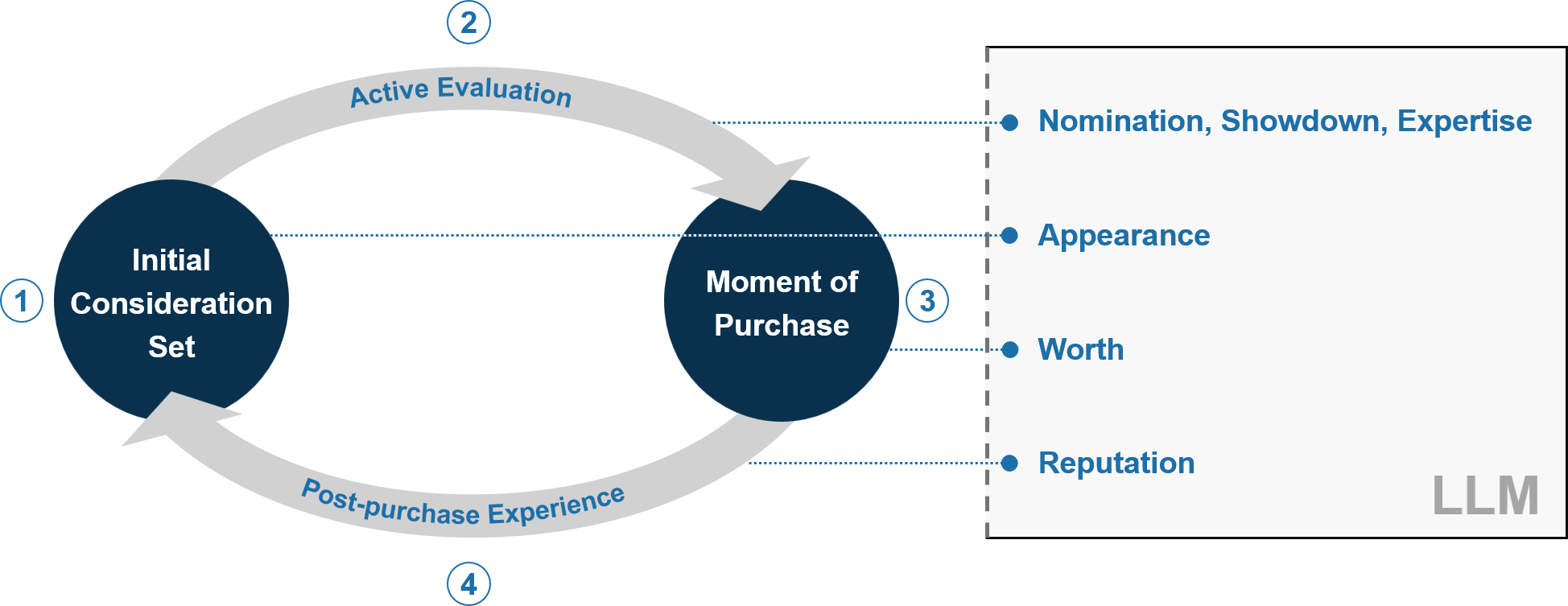
AI has not changed that truth. It has become the thing that assembles the set. Where a customer once built a shortlist from search results, review sites, and word of mouth, they now ask ChatGPT, Perplexity, or Google's AI answers and accept the names the engine returns. The decision journey still runs, it just runs through one answer. Appearance is whether you make it into that answer in the first place.
What Customers Actually Ask
Appearance is measured with open, category-level prompts that never mention your brand. The questions sound like a customer thinking out loud at the start of a search:
- "What are the best project management tools for agencies?"
- "Who are the leading industrial robotics companies in the United States?"
- "Top accounting software for small businesses in 2026."
The test across questions like these is simple. Does the engine name you, how often, and how near the top?
What Strong and Weak Appearance Look Like
Strong Appearance looks like being named, often near the top, across most category queries and across more than one engine. The engine reaches for you as a default answer when a customer asks who the leaders are.
Weak Appearance looks like being absent while competitors are named as the leaders. It can also look subtler than total absence. You might be named on Perplexity but missing on ChatGPT, named only for one narrow phrasing of the question, or named but buried at the bottom of a long list while rivals anchor the top. Each of these is a real gap, and each is invisible from the inside, because a customer who never sees you also never clicks, and nothing in your analytics records the brands an engine left out.
How AI Gets Appearance Wrong
There are a few common ways a brand fails Appearance. It can be absent entirely, because the sources an engine draws on do not associate your brand with the category. It can appear on one engine and not another, because different engines read different sources. It can appear only for generic phrasings and vanish the moment the question gets specific. And it can be crowded out by competitors who show up in more of the third-party lists and comparisons that engines synthesize.
We cover the most damaging version of this in When AI Never Names Your Brand, and we answer the specific questions brands ask in Why Doesn't ChatGPT Mention My Brand?.
How Appearance Is Scored
Within a HiBot audit, each captured answer is scored from 0 to 4 on how prominently your brand appears, from named first down to absent while rivals are present. Those response scores roll up into an Appearance score from 0 to 100, and a brand lands in a plain-language band from Dominant to Invisible.
Appearance also carries the heaviest weight in the overall HiBot Score, at 0.25. It leads the weighting because presence gates every other category. A brand that is invisible here cannot make up the ground anywhere else. The full scoring model is explained in How an ANSWER Audit Is Scored.
How to Improve Your Appearance
Improving Appearance starts with a simple idea: AI engines do not invent their answers, they synthesize them from sources. So the work is making sure the sources an engine reads clearly and consistently associate your brand with your category. This is the core of answer engine optimization (AEO), also called generative engine optimization (GEO).
In practice that means earning a place in the third-party lists and comparison pages engines lean on, stating your category and use cases in plain language on your own pages, keeping your name, description, and category consistent across the web so engines form a clear picture of what you are, and earning credible mentions and citations. Because different engines pull from different sources, it also means closing the gaps engine by engine rather than assuming one fix lands everywhere.
The full tactical guide is in How to Improve Your Appearance Score, and you can run a fast do-it-yourself check with The 10-Prompt Appearance Self-Check. To see how this plays out end to end, read From Invisible to Named.
Measure before You Act
You cannot improve a number you cannot see. The first step is to find out whether you appear at all, across the engines and the markets that matter to you, the way a neutral customer would see it. A manual spot check gives you a hint, but a real baseline means asking many category questions, logged out, in the right geography, across multiple engines, and scoring the results consistently.
That is what a HiBot audit delivers: your Appearance score, the detail behind it, and a ranked list of what to fix first. Download the ANSWER whitepaper to see the full framework, or request an AI visibility audit at hibot.com.