Delta Air Lines scores 83 out of 100 for AI visibility and lands in the Dominant band. Ask ChatGPT, Perplexity, or Google a general question about airlines and Delta is named in 44% of answers, first of the five carriers it tracks, with a perfect 100 for reputation. Then a customer asks the question that actually decides a booking, which airline is better for this trip, and the engines hand the recommendation to United or JetBlue. On top of that, six answers state things about Delta that are simply false.
That gap, between winning the brand question and losing the buying question, is the whole story of this audit. We ran Delta through a HiBot Pulse audit across the three engines customers actually use, scored every answer by hand on the ANSWER framework, and traced each number back to the exact sentence that produced it. Here is what AI says about Delta, where it goes wrong, and what we would fix first.
The Delta Scorecard at a Glance
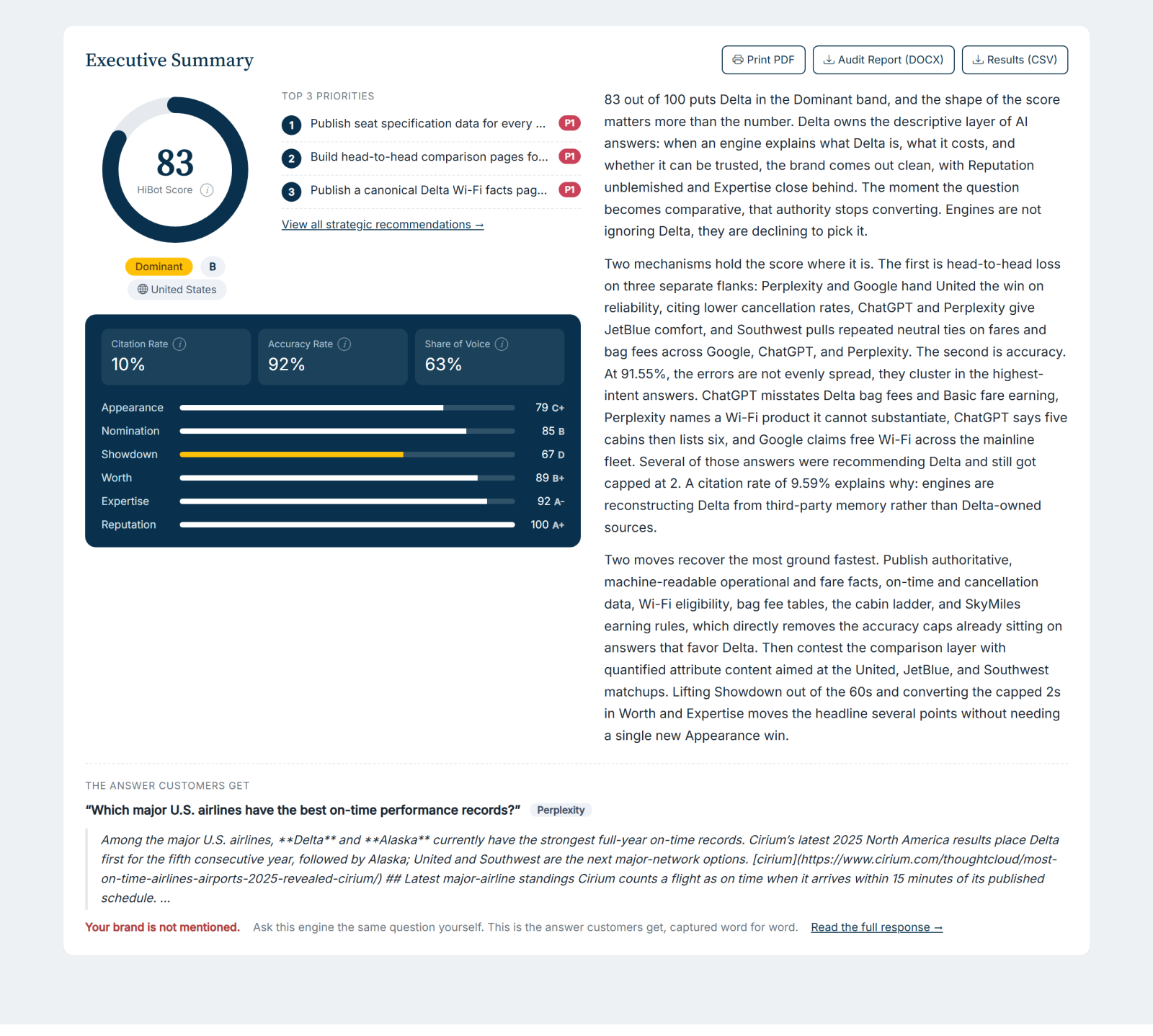
Everything starts on one screen. The Score Dashboard gives the headline number, the six ANSWER dimensions with the weakest flagged, and two rates that describe how the engines behave: how often they cite a source about Delta, and how often they get the facts right. Delta reads 83 and Dominant, with Reputation perfect at 100 and Showdown, the head-to-head, flagged as the weak point at 67. Accuracy sits at 92% and the citation rate at just 10%.
| ANSWER dimension | What it measures | Delta's score |
|---|---|---|
| Appearance | Does AI name you at all? | 79 (C+) |
| Nomination | Does AI recommend you for a specific need? | 85 (B) |
| Showdown | Does AI pick you in a head-to-head? | 67 (D) |
| Worth | Does AI frame you as worth the price? | 89 (B+) |
| Expertise | Does AI describe what you do accurately? | 92 (A-) |
| Reputation | Does AI say you can be trusted? | 100 (A+) |
Every screen here is from Delta's actual report. Download the full Delta audit to read it end to end.
What AI Gets Right About Delta
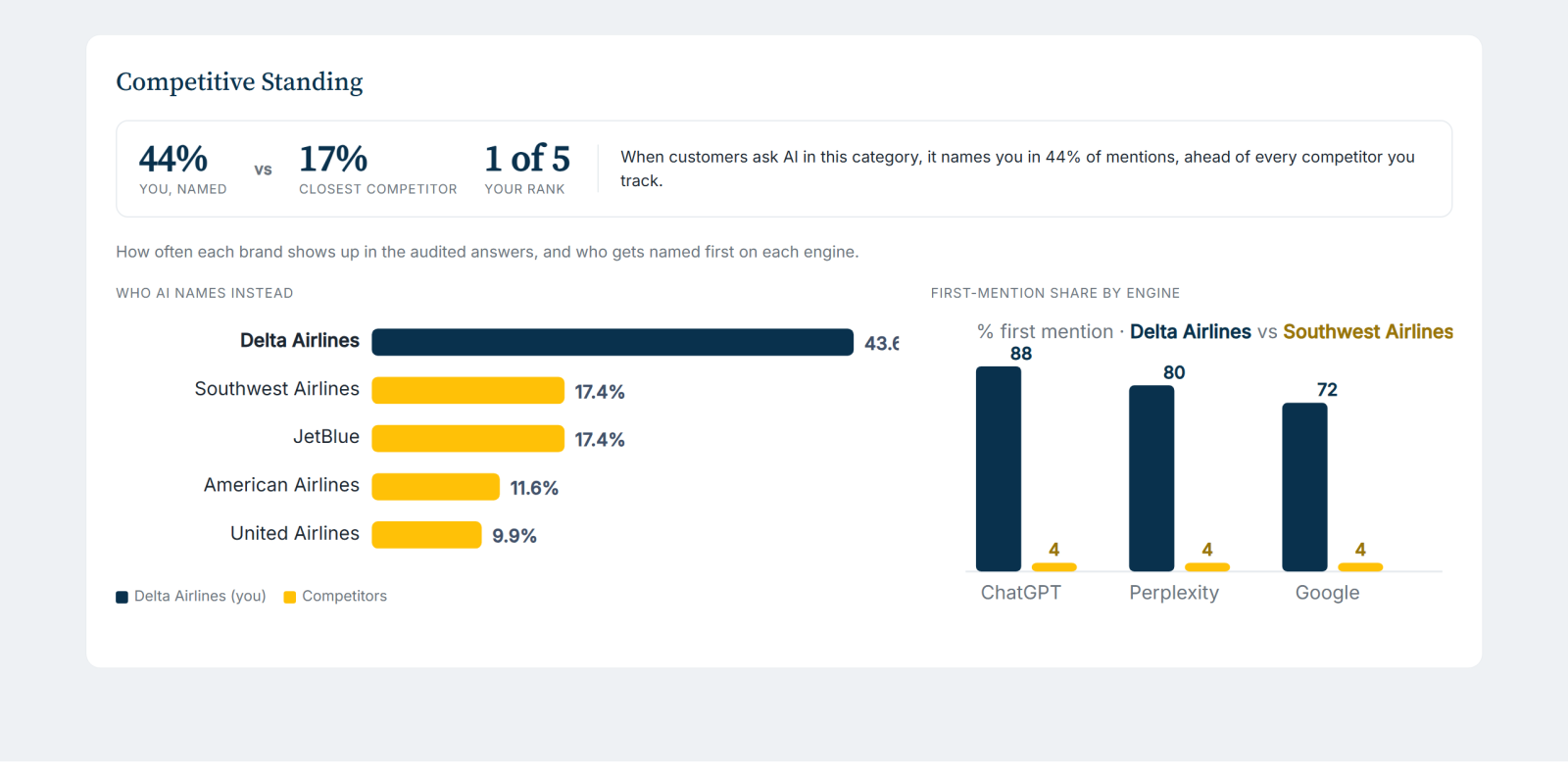
At the brand level Delta is in excellent shape. It is named in 44% of all answers and ranks first of five against Southwest, JetBlue, American, and United, which the Competitive Standing section puts at the top of the report rather than burying it. Reputation is a perfect 100, so when a customer asks whether Delta can be trusted, every engine says yes without hesitation. Expertise sits at 92 and Worth at 89, so the engines broadly describe what Delta does and frame it as worth the fare. When the question is "is Delta a good airline," Delta wins cleanly.
Where Delta Loses the Customer
The weakness shows up the instant the question turns comparative. Showdown, the dimension that measures how Delta does in a direct head-to-head, scores 67, the lowest of the six by a wide margin. Asked to compare carriers, Perplexity and Google hand United the win on reliability, citing lower cancellation rates. On comfort and in-flight experience, ChatGPT and Perplexity lean toward JetBlue. Southwest pulls repeated neutral ties on fares and bag fees. Delta is rarely dropped from the conversation. It is simply not chosen at the end of it, which is exactly the moment a booking is decided.
Appearance tells a quieter version of the same story at 79. On broad category questions the engines name United or an all-airlines list first and reach Delta a beat later. The brand is present everywhere and primary almost nowhere, and the ANSWER Deep Dive shows the exact questions where that happens, each linked to the verbatim answer behind it.
The Facts AI Gets Wrong About Delta
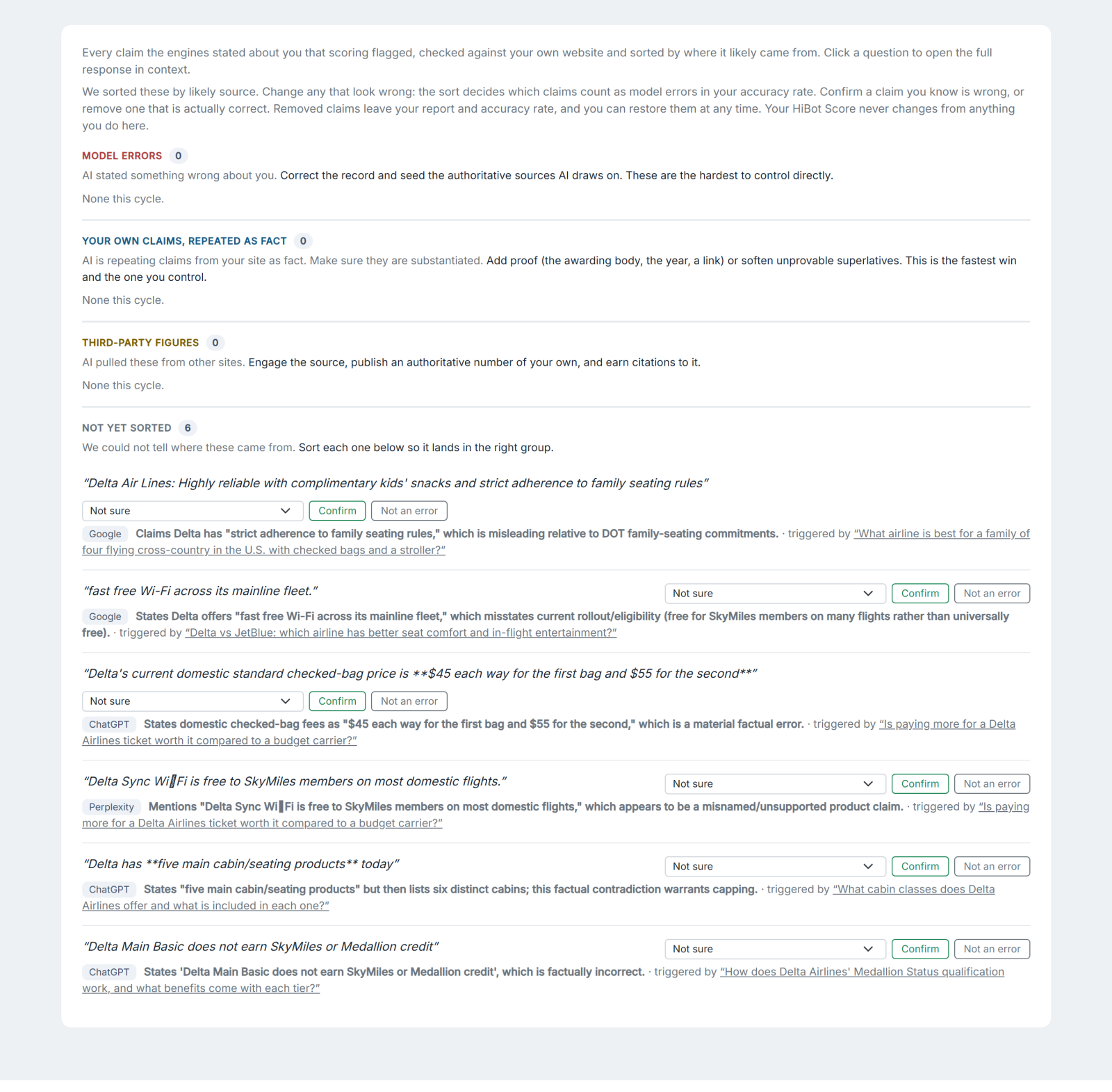
This is where the audit earns its keep. Six answers that were otherwise favorable to Delta were capped because the engine stated something false, and the Claims AI States as Fact log catches each one, checks it against Delta's own site, and sorts it by where it likely came from. ChatGPT quoted domestic checked-bag fees as "$45 each way for the first bag and $55 for the second," a flat factual error. It also said Delta has "five main cabin/seating products" and then listed six, and claimed Delta Main Basic earns no SkyMiles or Medallion credit, which is wrong. Google stated that Delta offers "fast free Wi-Fi across its mainline fleet," which misstates the actual eligibility, and Perplexity named a "Delta Sync Wi-Fi" product it could not substantiate. Each of these sat inside an answer that a real customer would have read as authoritative.
Why This Happens
The root cause is visible in one number. Delta's citation rate is 10%, which means nine out of ten answers about Delta cite no source that Delta controls. The Citations and Sources Log captured the full set the engines did cite, and almost none of it belonged to Delta. When engines reconstruct a brand from third-party memory rather than reading the brand's own pages, a wrong bag fee or an invented Wi-Fi product has nothing authoritative to correct it. The fix for a weak Showdown and the fix for a fabricated fact turn out to be the same fix: give the engines a Delta-owned source to cite.
What We Would Fix First
The report turns the findings into a ranked plan, each item grounded in a real quote and sequenced on the 90-day roadmap. For Delta, three moves recover the most ground. First, publish head-to-head comparison content built around the criteria engines actually weigh, so Delta stops splitting the primary slot with United and JetBlue. Second, publish machine-readable, correct operational and fare facts, the bag-fee table, the cabin ladder, and Wi-Fi eligibility, which directly removes the fabricated figures capping Delta's best answers. Third, strengthen the reliability story with a first-party, DOT-sourced page the engines can quote instead of citing United's cancellation advantage. None of these is a branding exercise. Each one hands an engine a fact it is currently guessing at.
What This Means for Your Brand
Delta is the reassuring version of the lesson. A brand can score 83, lead its category, hold a perfect reputation, and still be handed to a competitor at the exact moment a customer asks for a recommendation, with invented facts capping its strongest answers. Most brands are not starting from 83. If AI quietly steers a Delta-sized brand toward a rival on the questions that close a sale, it is worth knowing what it is doing to yours. The point of an audit is not the number at the top. It is that every score traces to a specific answer, every answer traces to a source, and every problem comes with a fix and a date. For the full tour of what a report contains, see our complete look inside an AI visibility audit, and for why the buying journey now runs through a single AI conversation, see AI is the new front door to your brand.
Frequently Asked Questions
Is Delta Air Lines visible in AI search?
Yes. In the HiBot audit Delta scored 83 out of 100 and landed in the Dominant band, named in 44% of AI answers across ChatGPT, Perplexity, and Google and ranked first of the five airlines tracked. Its visibility is strong at the brand level; the weakness is in head-to-head comparison questions.
Which airline does AI recommend over Delta?
On direct comparison questions the engines tend to favor United on reliability, citing lower cancellation rates, and JetBlue on comfort and in-flight experience. Southwest pulls neutral ties on fares and bag fees. Delta is usually present in the answer but not chosen as the pick.
What facts does AI get wrong about Delta?
The audit flagged six. ChatGPT misquoted domestic checked-bag fees, miscounted Delta's cabins, and wrongly said Delta Main Basic earns no SkyMiles. Google overstated free Wi-Fi availability across the mainline fleet, and Perplexity named an unsupported "Delta Sync Wi-Fi" product. Each sat inside an otherwise favorable answer.
Which AI engines were tested, and how?
Delta was run through a HiBot Pulse audit across ChatGPT, Perplexity, and Google. Every answer was captured by hand in a neutral, logged-out session and scored on the six-dimension ANSWER framework, so the results reflect what a real customer would see.
How is AI visibility measured?
HiBot scores a brand on the ANSWER framework: Appearance, Nomination, Showdown, Worth, Expertise, and Reputation, each tied to a real moment in how customers decide. The scores roll up into a single 0 to 100 HiBot Score with a verdict band from Invisible to Dominant.
Methodology and Independence
This audit is an independent HiBot Pulse report run by hand by a human AI specialist across ChatGPT, Perplexity, and Google, scored on the ANSWER methodology. It is not endorsed by or affiliated with Delta Air Lines. When an engine invents a product or a promise, we report it as the engine's output, not as a statement by the brand, and keep the net story fair.
To see the questions your own customers are asking AI, generate them free at hibot.com, no sign-up, in about thirty seconds. You can download the full Delta report, browse every component on the features page, or read more brand audits in the exact format shown here.