Accenture scores 95 out of 100 for AI visibility, one of the highest results in our published audits, and sits at the top of the Dominant band. ChatGPT, Perplexity, and Google know the firm cold, describe it with a perfect accuracy rate, and treat it as completely trustworthy. There is only one thing the engines will not do. They will not name it first. Across the questions that decide a shortlist, Accenture is Tier 1, favorably framed, and recommended, just never the single answer.
That is the runner-up effect, and it is a subtler problem than a wrong fact or a lost comparison. We ran Accenture through a HiBot Pulse audit across the three engines buyers use and scored every answer by hand on the ANSWER framework. Here is where a near-perfect brand still leaks the recommendation.
The Accenture Scorecard at a Glance
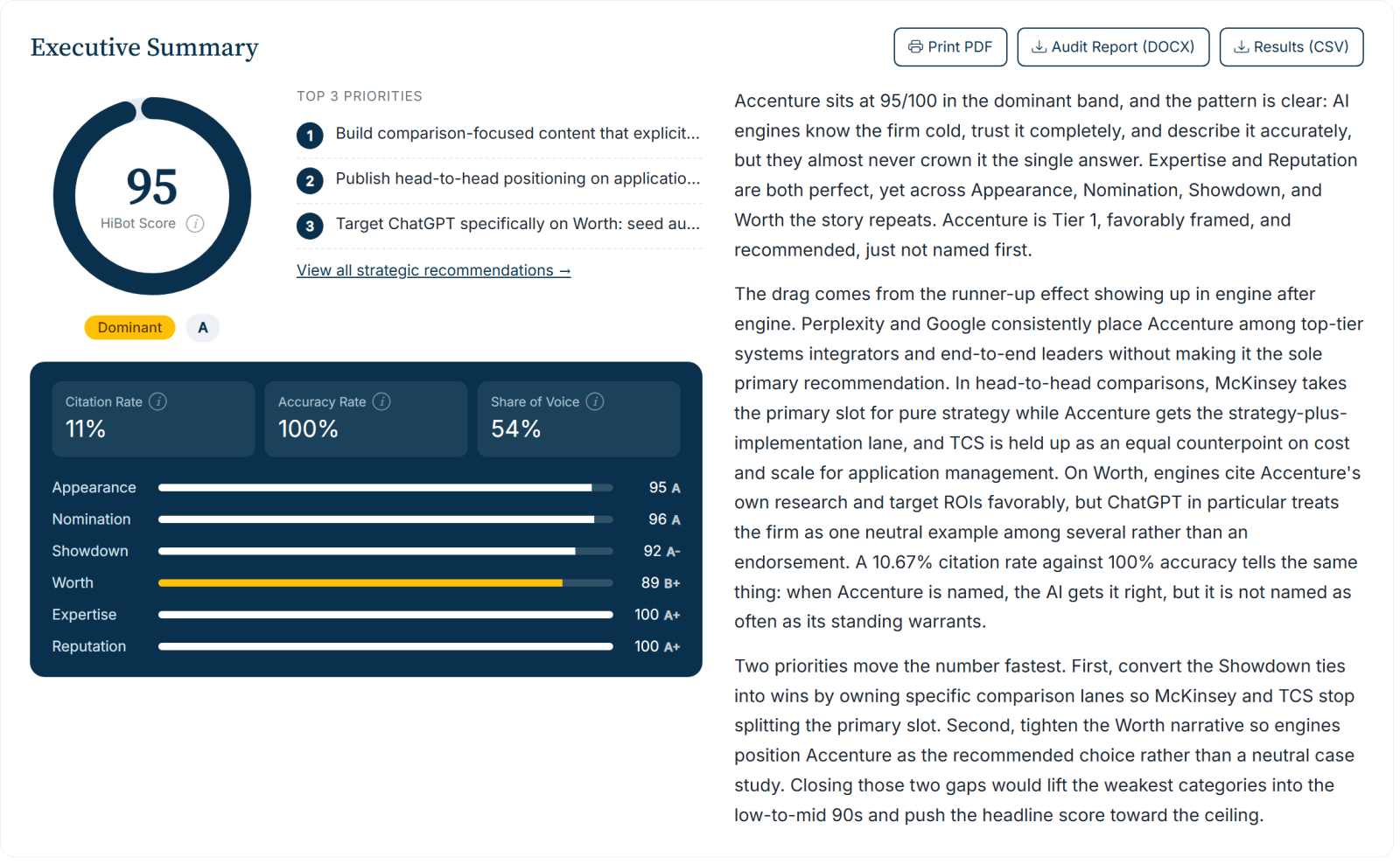
The Score Dashboard leads with the headline number and the six dimensions. Accenture reads 95 and Dominant, with Expertise and Reputation both perfect at 100 and an accuracy rate of 100%. There is no weak dimension in the usual sense. Appearance is 95, Nomination 96, Showdown 92, and Worth 89. The gap is about primacy, not presence.
| ANSWER dimension | What it measures | Score |
|---|---|---|
| Appearance | Does AI name you at all? | 95 (A) |
| Nomination | Does AI recommend you for a specific need? | 96 (A) |
| Showdown | Does AI pick you in a head-to-head? | 92 (A-) |
| Worth | Does AI frame you as worth the price? | 89 (B+) |
| Expertise | Does AI describe what you do accurately? | 100 (A+) |
| Reputation | Does AI say you can be trusted? | 100 (A+) |
Every screen here is from Accenture's actual report. Download the full audit to read it end to end.
What AI Gets Right About Accenture
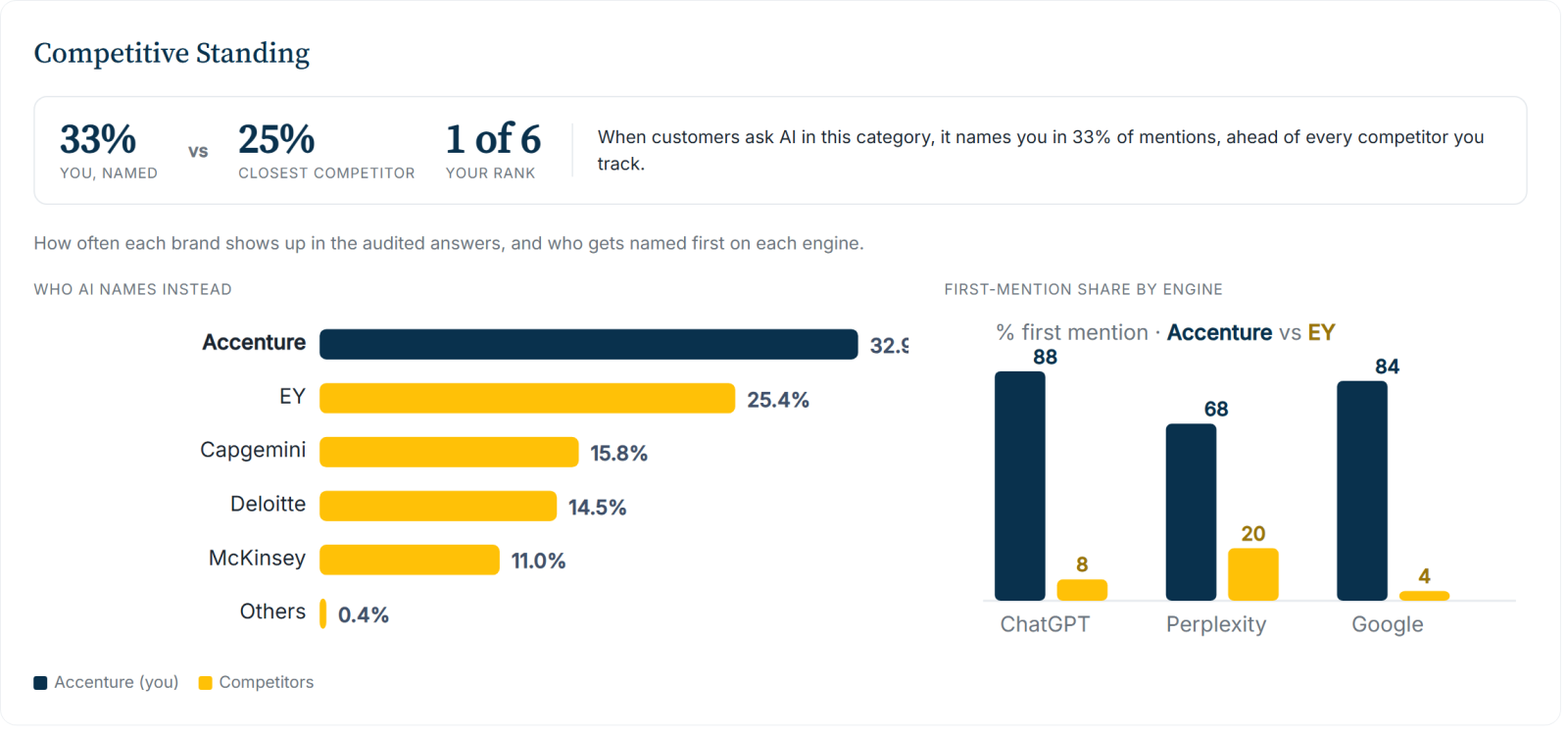
Almost everything. The engines name Accenture in 33% of category answers and rank it first of six against EY, Capgemini, Deloitte, and McKinsey, which the Competitive Standing section puts at the top of the report. Accuracy is a perfect 100, which is rare: not a single claim the engines made about Accenture was flagged as wrong. When a customer asks what Accenture does or whether it can be trusted, the engines answer accurately and favorably every time.
Present Everywhere, Primary Nowhere
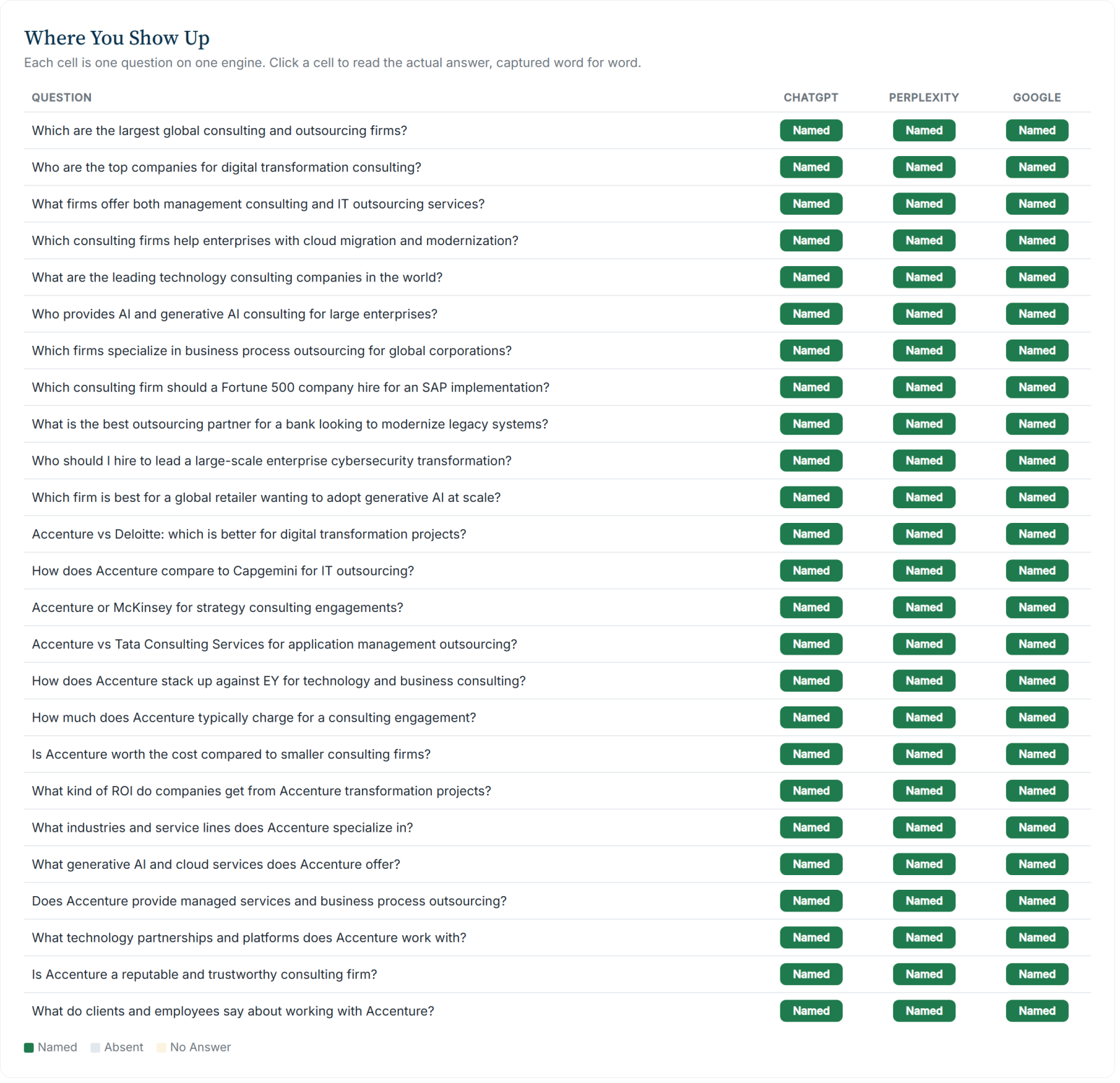
The weakness is visible in the presence grid. Accenture appears in nearly every relevant answer, yet rarely as the first firm named. Perplexity and Google place it among top-tier systems integrators without making it the sole primary recommendation. In head-to-head comparisons, McKinsey takes the primary slot for pure strategy while Accenture gets the strategy-plus-implementation lane, and TCS is held up as an equal counterpoint on cost and scale. The Where You Show Up grid shows the pattern at a glance: named almost everywhere, first almost nowhere.
Why This Happens
With a perfect accuracy rate, Accenture's issue is not fabrication. It is positioning. The citation rate sits at 11%, so even a firm this strong is being assembled by the engines from third-party memory rather than from Accenture's own positioning content. The Citations and Sources Log shows which domains the models trust in the category, and they are mostly not Accenture's. When the engines reach for the primary recommendation, they default to whichever firm the broader web frames as the category's first name, and for pure strategy that is still McKinsey.
What We Would Fix First
The report ranks the moves on the 90-day roadmap. For Accenture, the work is comparative positioning, not correction. First, publish comparison content that explicitly claims the pure-strategy lane against McKinsey, so the engines stop defaulting McKinsey to the primary slot. Second, publish head-to-head positioning on application management versus TCS that reframes the choice around outcomes rather than cost and scale. Third, seed third-party-verifiable ROI case studies so ChatGPT moves from neutral mention to active recommendation on value.
What This Means for Your Brand
Accenture is the hardest version of the lesson, because nothing is broken. The brand is accurate, trusted, and named, and still it leaks the recommendation to a rival the engines have simply decided to name first. If a 95 can be quietly kept out of first place, a brand with any real weakness is being passed over far more often. For the full tour of what a report contains, see our complete look inside an AI visibility audit, and for why the buying journey now runs through a single AI conversation, see AI is the new front door to your brand.
Frequently Asked Questions
Is Accenture visible in AI search?
Yes, highly. Accenture scored 95 out of 100, among the strongest results in our audits, named in 33% of AI answers across ChatGPT, Perplexity, and Google and ranked first of six firms, with a perfect accuracy rate.
Why doesn't AI name Accenture first?
The engines treat Accenture as Tier 1 and recommend it, but default the primary slot to a rival: McKinsey on pure strategy, and TCS as an equal on cost and scale. It is a positioning gap, not an accuracy or trust gap.
What facts does AI get wrong about Accenture?
None flagged. Accenture's accuracy rate was a perfect 100%, meaning the engines made no claims the audit judged false. Its only weakness is being named second rather than first.
Which AI engines were tested, and how?
Accenture was run through a HiBot Pulse audit across ChatGPT, Perplexity, and Google. Every answer was captured by hand in a neutral, logged-out session and scored on the ANSWER framework.
How is AI visibility measured?
HiBot scores a brand on the ANSWER framework: Appearance, Nomination, Showdown, Worth, Expertise, and Reputation, rolled into a single 0 to 100 score.
Methodology and Independence
This audit is an independent HiBot Pulse report run by hand by a human AI specialist across ChatGPT, Perplexity, and Google, scored on the ANSWER methodology. It is not endorsed by or affiliated with Accenture.
To see the questions your own customers are asking AI, generate them free at hibot.com, no sign-up, in about thirty seconds. You can download the full Accenture report, browse every component on the features page, or read more brand audits in the exact format shown here.