The customer decision journey used to spread across search results, review sites, and word of mouth. Now it runs through a single AI answer. When a customer asks ChatGPT, Perplexity, or Google's AI answers which product to choose, the engine surfaces a few names, recommends one, compares it against rivals, and passes judgment on price and trust. That one reply is the journey.
Which means there are now a handful of specific places a brand can quietly fall out of it. Each leak maps to a stage of McKinsey's Consumer Decision Journey, and each is measured by a category of HiBot's ANSWER framework. Here is where brands lose customers they never knew they had a shot at.
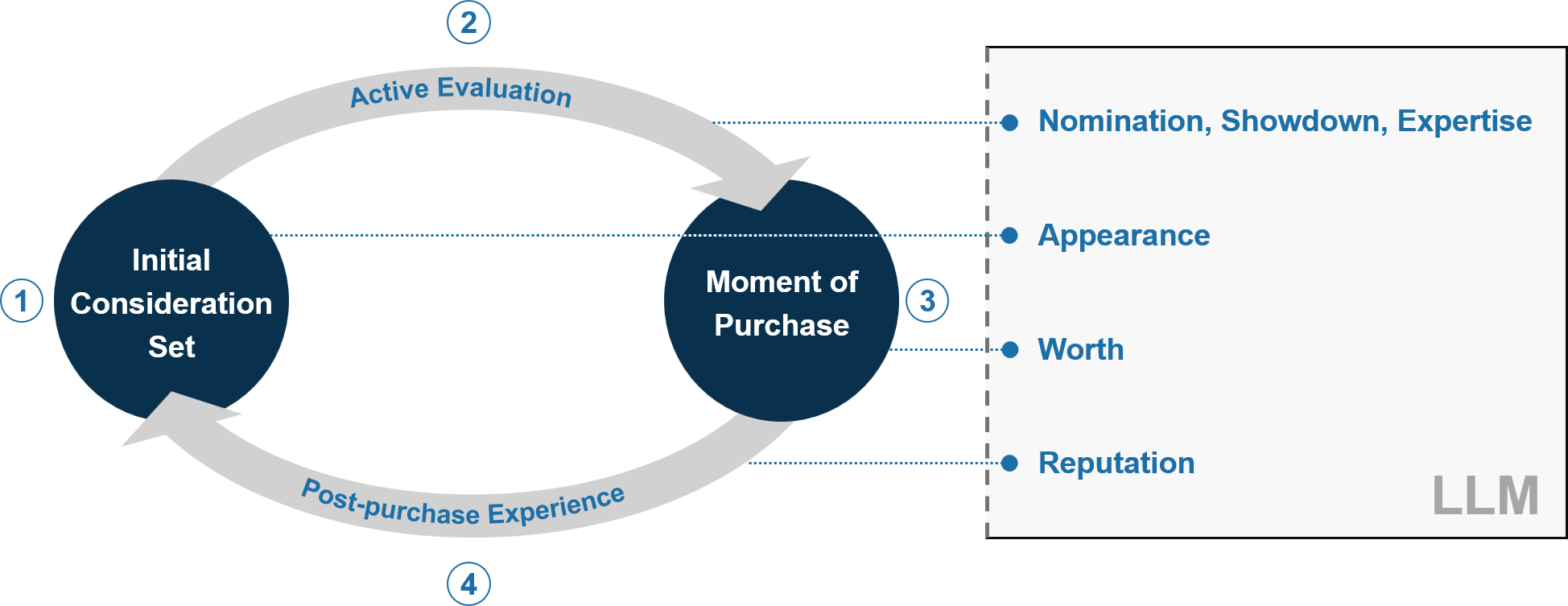
1. You Never Show Up (Appearance, the Consideration Stage)
The first leak is the worst, because it caps every stage after it. When a customer asks an open category question, like "what are the best project management tools for agencies," the engine names a handful of brands. If yours is not one of them, you are not in the running. You are never compared, priced, or trusted, because you were never in the room. This is a failure of Appearance, and it is completely invisible. The customer never sees you, and you never see the customer.
2. You Make the List but Never the Pick (Nomination, Active Evaluation)
Showing up is not the same as being chosen. Plenty of brands appear in the broad category list and are never the actual recommendation for a real situation. Ask "which CRM is best for a 5-person real estate team" and the engine puts one brand forward for that job. If it is always a competitor, you are leaking at Nomination. You look present in a generic answer, but you lose every time the question gets specific, which is exactly when the customer is closest to buying.
3. You Lose the Head-to-Head (Showdown, Active Evaluation)
Customers ask AI to choose for them. "Brand A vs Brand B for enterprise, which is better" is a question the engine answers directly, and its answer settles the comparison. If the engine misreads your strengths, leans on a competitor's marketing, or drops you before the comparison is even fair, you lose a deal at the exact moment it was decided. Showdown is where many sales are won and lost. A brand can be strong everywhere else and still leak right here.
4. You're Priced Wrong at the Worst Moment (Worth, the Purchase)
Near the decision, customers ask AI about cost and value, as in "is it worth the price for a small business?" If the engine quotes an outdated number, invents a higher one, or frames you as overpriced, it suppresses purchase intent just as the customer is ready to commit. The same leak shows up in Expertise, when AI invents a limitation or misses a feature you actually have. Either way, a confident, wrong answer disqualifies you, and the customer never hears your side.
5. A False Claim Poisons Your Trust (Reputation, the Loyalty Loop)
The last leak is the hardest to fix after the fact. When a customer asks "is this company reliable," the engine renders a verdict on trust. If it repeats an old complaint, surfaces a stale controversy, or in the worst case claims you have shut down, it does damage you cannot see and did not cause. Reputation closes the loop and shapes the next customer, so a poisoned answer here costs you customers you may never appear in front of again.
What These Leaks Have in Common
None of them show up in your analytics. A customer who asks AI, gets a recommendation, and never visits your site leaves no trace in your funnel. You can lose the sale before you knew there was one. The only way to find the leaks is to measure what AI actually says about you, stage by stage, the way a neutral customer would see it.
That is what a HiBot AI visibility audit, built on the ANSWER framework, does. It scores all 6 categories, shows you exactly where you are leaking, and ranks what to fix first.
Find your leaks before your competitors benefit from them. A HiBot audit gives you a neutral, stage-by-stage baseline across the full ANSWER framework. Download the ANSWER whitepaper to see the method, or request an AI visibility audit at hibot.com.