A HiBot audit has always told you how AI answer engines like ChatGPT, Perplexity, and Google see your brand: a headline score, six ANSWER dimensions, and the verbatim answers behind each one. That settles the first question every brand has. Where do we stand? It leaves the harder question open. What do we actually do about it?
Over a few weeks this month we rebuilt the report to answer that second question. The score is still there. Around it now sits a prioritized action plan, grounded in the real answers the engines gave, and built to hand to whoever does the work. Here is everything in it, feature by feature, and why each one earns its place.
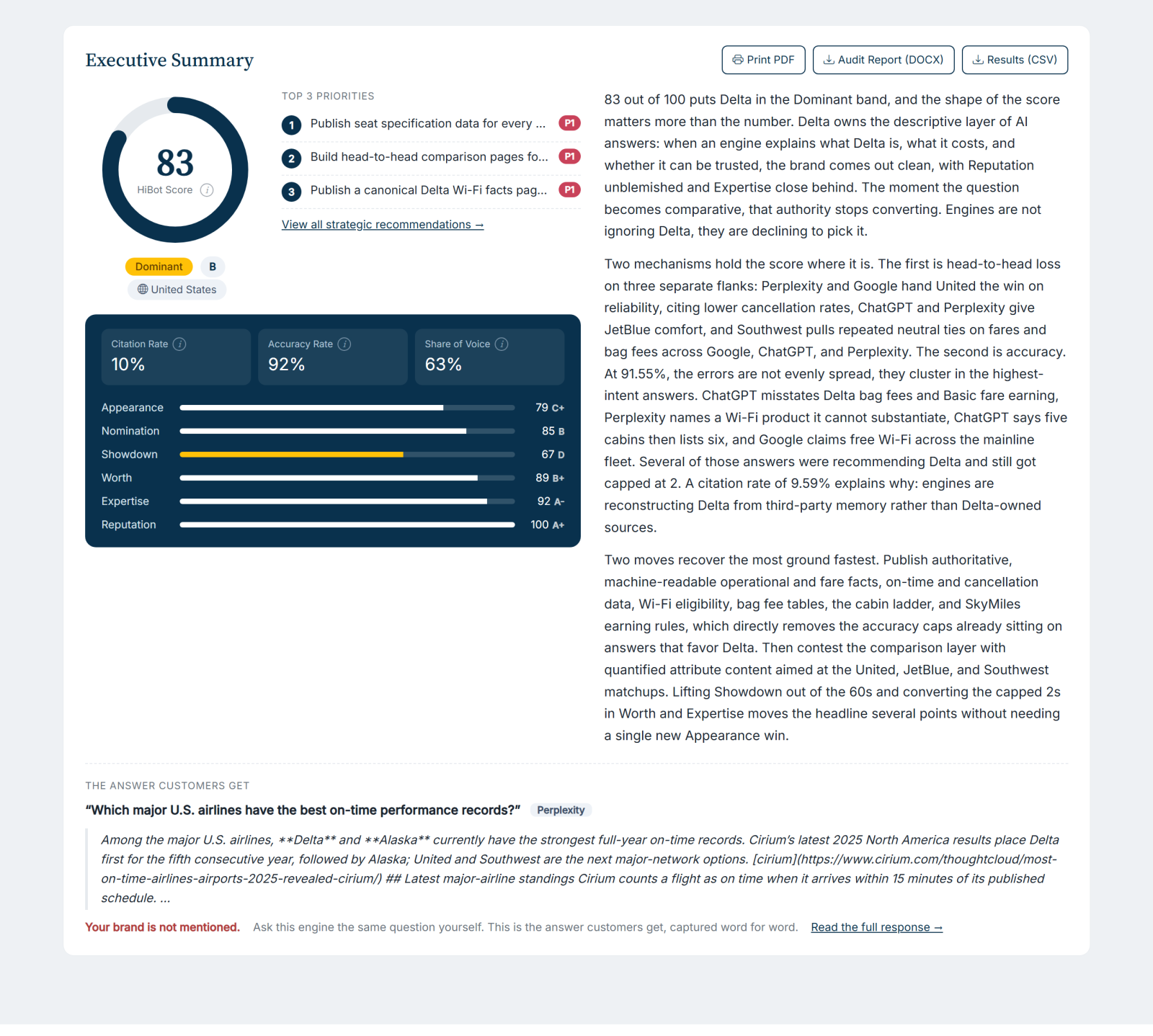
Shown above and throughout: real screens from the Delta Airlines case study audit report.
The Score Was Never the Point
Most AI visibility tools stop at a number. A number is a scoreboard, not a game plan. The people who actually move a brand's visibility, the marketer, the SEO lead, the agency strategist, do not need to be told they are losing. They need to know which fix will move the needle first, what evidence backs it, and how to sequence the work. The new report is organized around that need from top to bottom.
The Impact-Effort Prioritization Matrix
The action plan opens with an impact-effort matrix. Every recommendation is plotted by the impact it will have against the effort it takes, sorted into four quadrants: quick wins in the top-left, big bets in the top-right, fill-ins in the bottom-left, and time sinks in the bottom-right. The first thing you see is the shortest path to a higher score, not a wall of text.
Why it matters: prioritization is where most audits fall apart. A list of twenty fixes with no ranking is paralyzing. The matrix turns that list into a decision you can make in ten seconds, and it recolors as you mark items complete, so progress is visible at a glance. Each point is numbered and links straight to its full detail below.
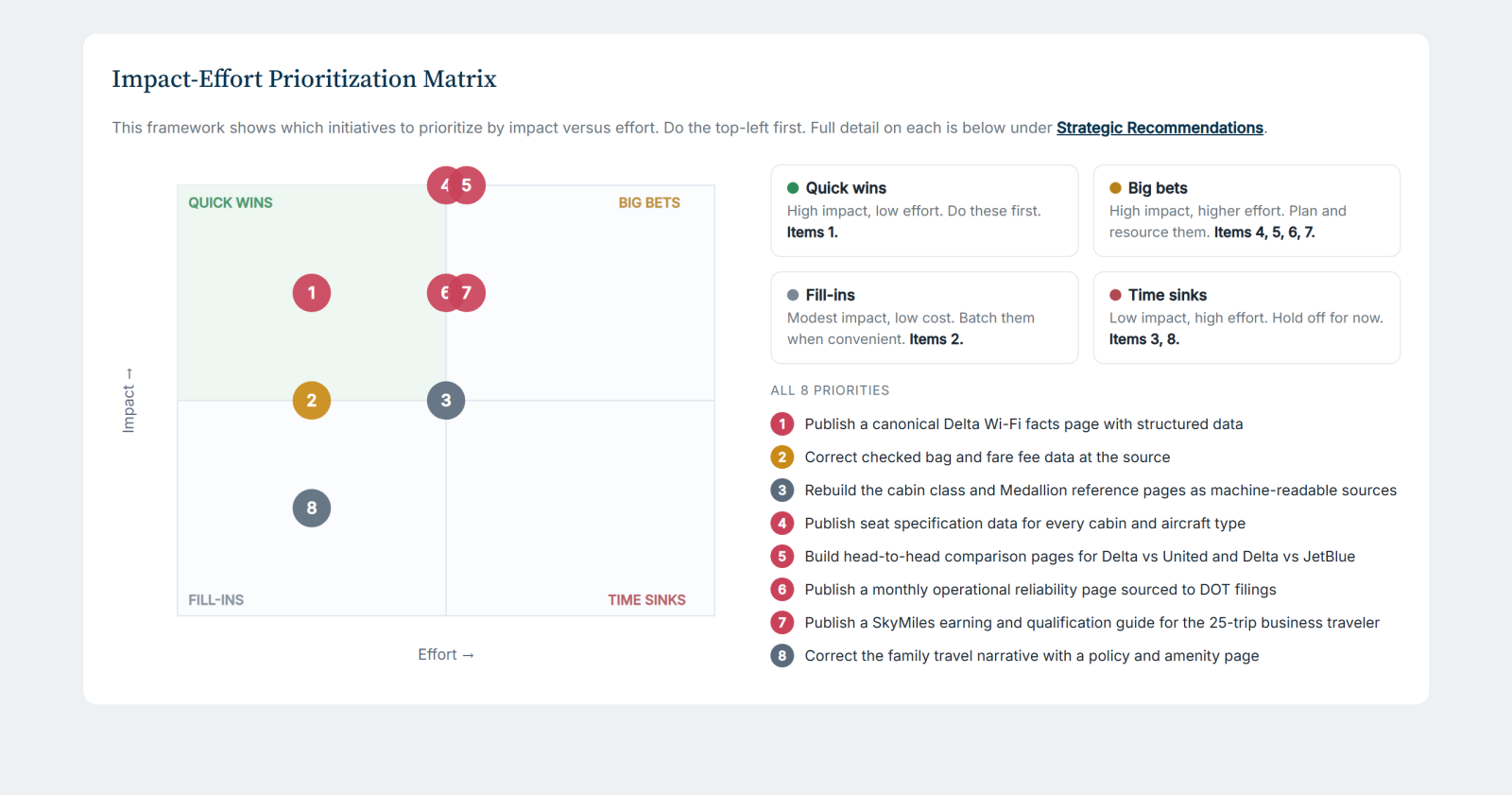
See the impact-effort matrix on the features page for a live example.
Recommendations Grounded in Evidence
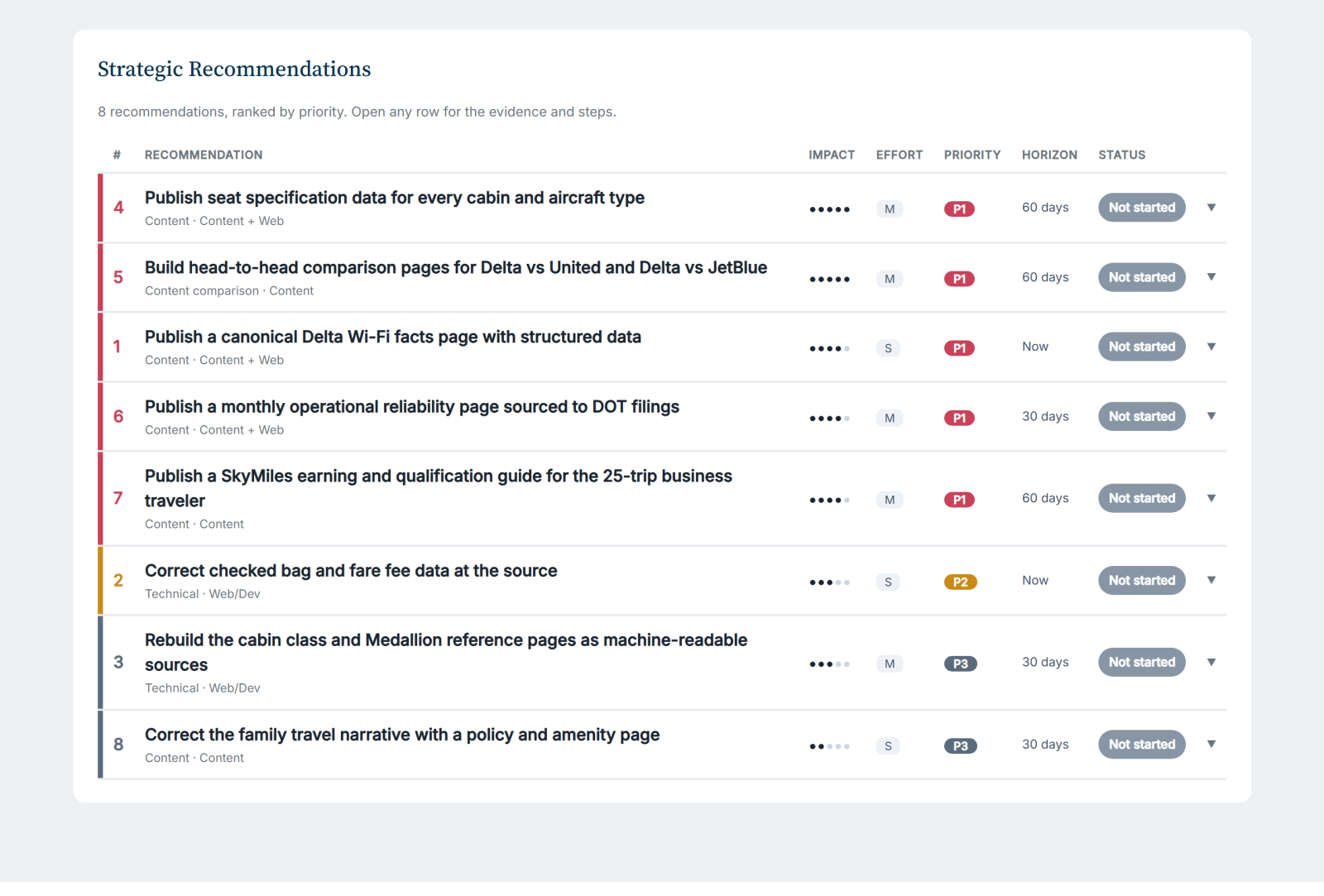
Below the matrix, every recommendation is laid out in priority order, each tagged with its impact, effort, and time horizon. Open one and you see four things: the problem, the evidence for it pulled as direct quotes from the captured AI answers, the recommended steps, and the expected outcome. Nothing is a black box.
This is the part customers tell us they trust. When the report says an engine is quietly recommending a competitor over you, it shows you the exact sentence where that happened, tags the issue (an omission, a fabrication, a stale claim), and names the engine that said it. You are not asked to take our word for anything. The audit shows its work.
Status and Notes You Save on the Report
Each recommendation carries a status you set (not started, in progress, complete) and a notes field you save right on the report. Mark what you have started, jot down what you tried, and the report stops being a static PDF and becomes your working tracker. Come back a month later and the state of the work is where you left it. It also means the recoloring matrix and the roadmap reflect real progress, not a snapshot frozen on delivery day.
Explore the tracked recommendations in detail.
The 90-Day Roadmap, Wired to Your Calendar
The recommendations are then sequenced into 14, 60, and 90-day horizons, each with its own score target. The plan does not just say what to fix, it says when, and what a good result looks like by that date.
Every milestone has a one-click Google Calendar link and an .ics download, and you can add an entire milestone to your calendar at once. This is the difference between a plan that gets done and a plan that dies in a downloads folder. The deadline lands in the calendar of the person responsible, not in a document nobody reopens.
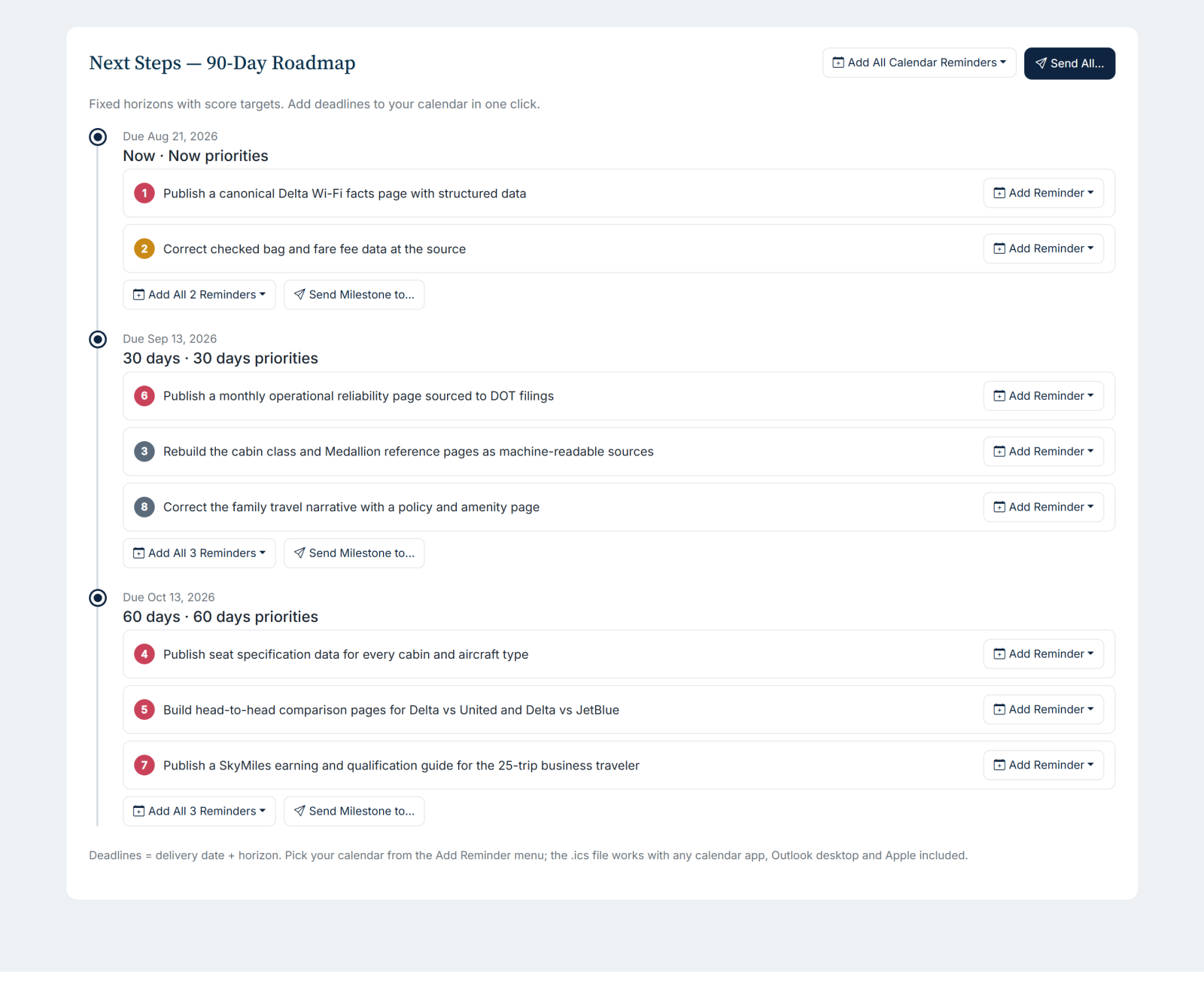
See the 90-day roadmap for the full layout.
The ANSWER Deep Dive
Behind the plan sits the diagnosis: a category-by-category read on each of the six ANSWER dimensions, written in plain language, with the exact customer questions we asked in each one. Every question links through to the verbatim answers that produced its score, so a reader can go from "why is my Appearance score low?" to the actual sentences an engine returned, in one click. See the ANSWER deep dive.
Word, PDF, and CSV Exports
A report is only useful if you can move it. Every audit now exports three ways. There is an editable Word document, with the impact-effort matrix rendered as a real diagram, so you can add your own commentary before you send it on. There is a clean, print-ready PDF to circulate. And there is a CSV of every question and every response, ready to drop into your own analysis or a client's spreadsheet.
Why it matters: audits get consumed in other people's tools. The Word export means a consultant can localize the language and add a cover note. The CSV means an analyst can pivot the raw data any way they like. You are never locked into our view of your own results.

Compare the export formats.
White-Label Delivery for Agencies and Consultants
For agencies, consultants, and fractional CMOs, the whole report goes white-label. Add your report name and logo, and every HiBot reference is neutralized to a plain "AI Visibility Score." The client sees your work, not ours, and the white-labeling carries through to the Word and PDF exports too.
This is what makes HiBot a service you can resell rather than a tool you quietly use. Run the audit, brand the deliverable, and hand a client a polished AI visibility report with your name on it. See white-label reports.
Common Questions
What is included in a HiBot audit report?
A headline HiBot Score and six ANSWER dimension scores, a per-dimension deep dive with the real questions and verbatim AI answers, an impact-effort matrix, tracked recommendations grounded in evidence, a 90-day roadmap with calendar reminders, and Word, PDF, and CSV exports. Competitive standing and share of voice are included whenever you track a competitor.
Can I edit the report or add my own notes?
Yes. You set a status and save notes on each recommendation directly in the report, and the editable Word export lets you add commentary or restructure the document before sending it to a client.
Can I deliver audits under my own brand?
Yes. White-label mode puts your logo and report name on every page and export and removes all HiBot branding, so you can resell audits as your own AI visibility service.
Want to see the full report on a real brand? We publish complete example audits, in the exact format you receive, on the case studies page. Browse every report component on the features page, or request your own audit to get a scored diagnosis and a plan you can act on this week.