There is a tempting shortcut for any company curious about its AI visibility: open ChatGPT, ask about your own brand, and read the answer. Do not trust what you see. Logged in, the engine draws on your history and tells you a flattering story no prospective customer would ever get. A real measurement has to reproduce what a neutral stranger sees, and doing that properly takes more than a few searches.
A HiBot AI visibility audit, built on the ANSWER framework, runs in 4 phases. The discipline in each is what separates a real baseline from a few lucky screenshots.
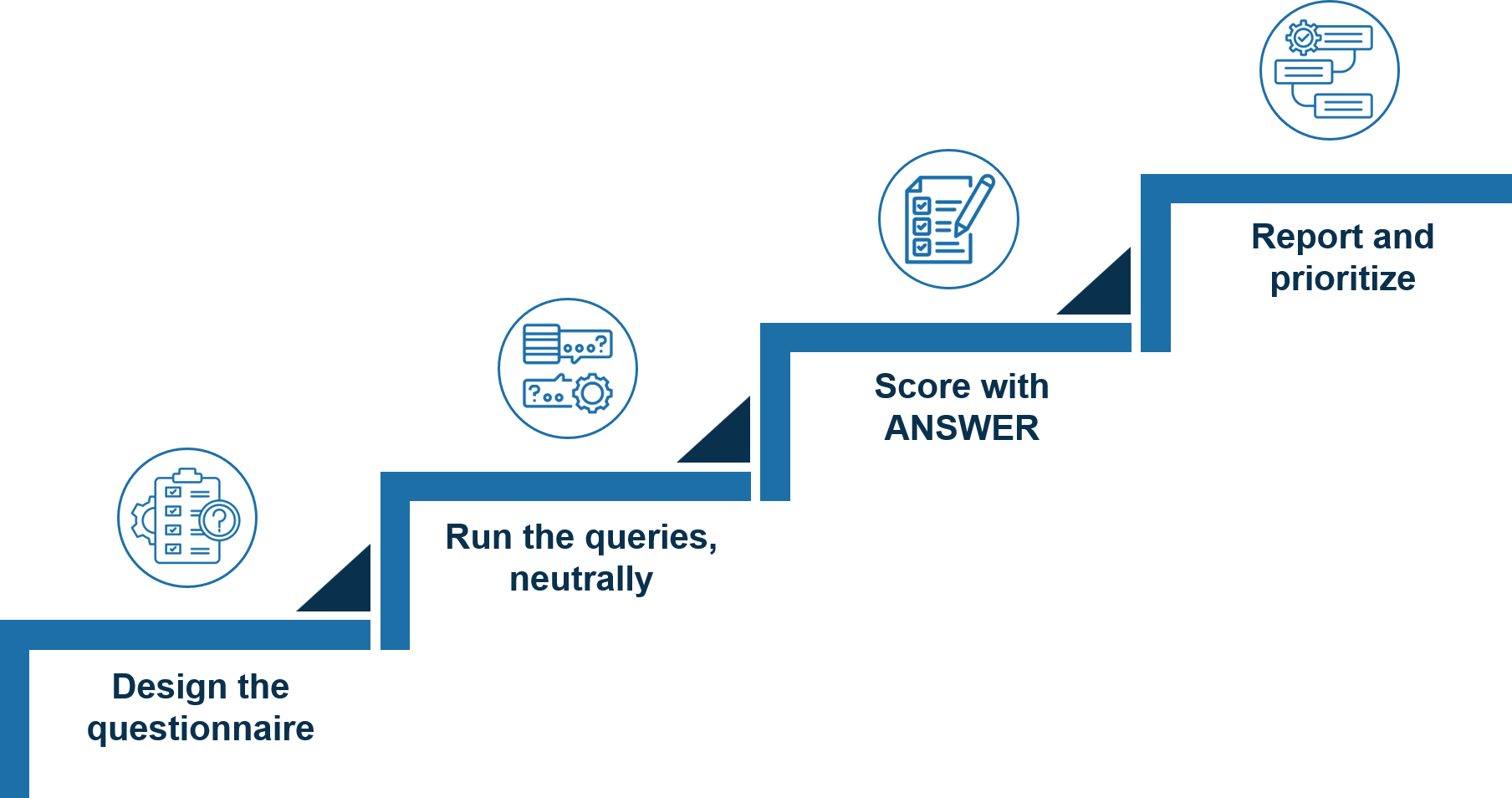
Exhibit: the 4-phase ANSWER audit, from questionnaire design to a prioritized report.
Phase 1: Design the Questionnaire
Every audit starts with a question set written in the customer's own language, across all 6 ANSWER categories and tuned to your real competitors, use cases, and markets. The questions are weighted toward Appearance and Showdown, because presence and direct comparison move outcomes the most.
The tier sets the scope. HiBot Pulse is 25 questions across 3 AI engines (ChatGPT, Perplexity, and Google's AI answers). HiBot Panorama is 50 questions across 5 engines, adding Claude and Grok, and runs each question twice.
Phase 2: Run the Queries, Neutrally
This is where most homegrown attempts fall apart. The goal is a neutral baseline: what a genuine prospective customer would see, not a personalized echo. A human specialist, not a scraper, asks every question by hand under 5 rules:
- Logged out and neutral. Each query runs in a fresh, logged-out session, so the result is a neutral baseline rather than one user's personalized history.
- A fresh chat per question. Every question gets a new conversation, so one answer cannot color the next.
- In the brand's target geography. Queries run in the market the brand sells into, because AI answers vary by location.
- Across multiple engines. Every engine in the tier gets the same question, because a brand can be strong on one and absent on another.
- Captured verbatim. The specialist records the full response and the sources each engine cited, so the result can be scored and revisited.
The effort is easy to underestimate. A Panorama audit is 50 questions across 5 engines, run twice, which is 500 separate answers, each opened in its own clean session, set to the right geography, and captured word for word. By a conservative estimate, doing that by hand runs approximately 20 hours of skilled work, and it has to be repeated every time you want to see whether the number moved.
Phase 3: Score with ANSWER
Scoring is applied by AI to the captured text only. The scorer reads what the specialist recorded and never re-queries an engine, so the measurement is fixed before it is judged. Each answer is scored from 0 to 4, capped at 2 if it contains a factual error or negative framing, then rolled up into a weighted HiBot Score from 0 to 100 and a plain-language band that runs from Dominant to Invisible. The full model is laid out in "How an ANSWER Audit Is Scored."
Phase 4: Report and Prioritize
The audit ends in a consulting-grade report, not a raw data dump. You get your HiBot Score and band, the breakdown by category and by engine, accuracy and citation metrics, and a ranked list of what to fix first. That ranking is the point: it turns a diagnosis into an action plan.
None of this is exotic. It is simply disciplined, repeated across every question, engine, and run, then done again next quarter as AI answers shift with each model update. That discipline is the honest reason most teams do not do it themselves, and it is the foundation the HiBot Score rests on.
A HiBot audit handles all 4 phases for you and turns them into a baseline you can track quarter over quarter. Download the ANSWER whitepaper to see the full method, or request an AI visibility audit at hibot.com.